
Maintenance Category
A category is the template for a type of work, such as Plumbing, HVAC, Locks, or Electrical. Every new work order copies its checklist, time target, inspection rule, and parts setting from the category chosen at creation.
What you set up
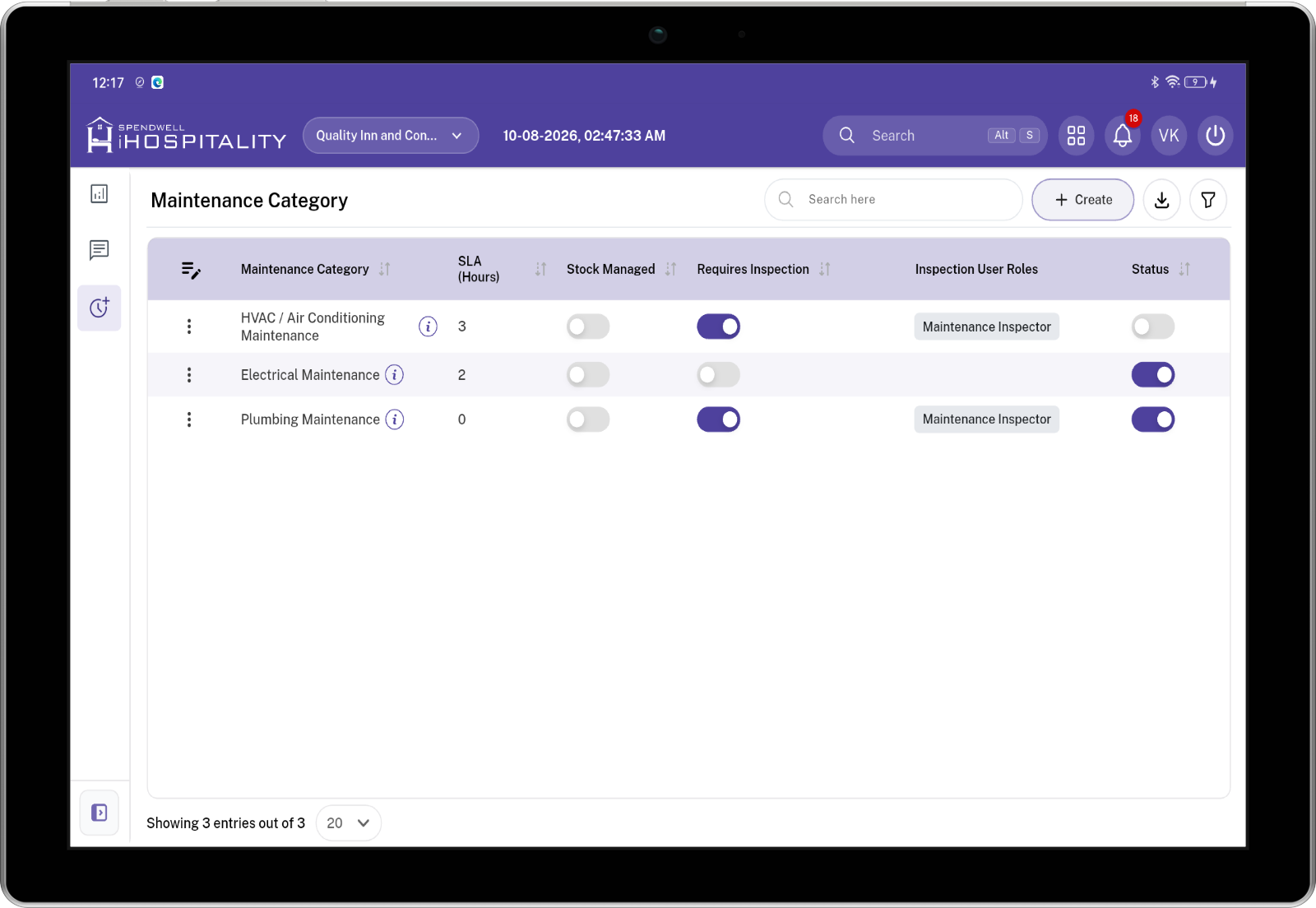
| Setting | What it does |
|---|---|
| Maintenance Category | The name people pick when they create a work order. Each property can have only one category with that name. Plumbing and plumbing count as the same name. |
| SLA (Hours) | How many hours the hotel allows from the moment the problem is reported. Zero means this kind of work has no time target. |
| Stock Managed | Turn on when technicians are expected to record parts for this kind of work. |
| Requires Inspection | Turn on when a second person must check the work before the work order can be completed. |
| Inspection User Roles | The job roles allowed to inspect. This list appears only when Requires Inspection is on. At least one role is required then. |
| Status | Active categories appear when someone creates a work order. Inactive categories stay on old work orders and drop out of the choice list. |
Company and property come from the property you are logged into.
Inspection User Roles
Turn on Requires Inspection, then choose the roles that may inspect, such as Maintenance Inspector.
Until someone starts the inspection, any active person at the property who has one of those roles can open the work order and start it. The first person who starts is the inspector for that work order from then on.
Leave inspection off when the technician is trusted to close the work order themselves.
Checklist
The checklist tab is required. Each row is one step, done from top to bottom.
| Column | What to enter |
|---|---|
| Display Order | The step number. The board follows this order. |
| Checklist Item | The step name, up to 100 characters. The same name cannot be used twice at the same display order. |
| Status | Active steps are copied onto new work orders. Inactive steps are kept on the category and left off new work orders. |
| Require Notes & Photos | Turn on when that step needs a written note or a photo before it can be marked done. |
Example for Plumbing:
| Order | Step | Notes and photos | Active |
|---|---|---|---|
| 1 | Shut off the water supply | No | Yes |
| 2 | Replace the supply line | Yes | Yes |
| 3 | Test for leaks | No | Yes |
On a new work orderorder, every copied step starts as not done. Only active steps are copied.
How to add a category
- Open Maintenance Category and add a record.
- Enter the name.
- Set SLA (Hours). Use zero when this work has no deadline.
- Turn on Requires Inspection only when someone else must check the
work,work; then choose the inspection roles. - Turn on Stock Managed when parts should be recorded for this work.
- Add the checklist steps in the order the work is done.
- Save.
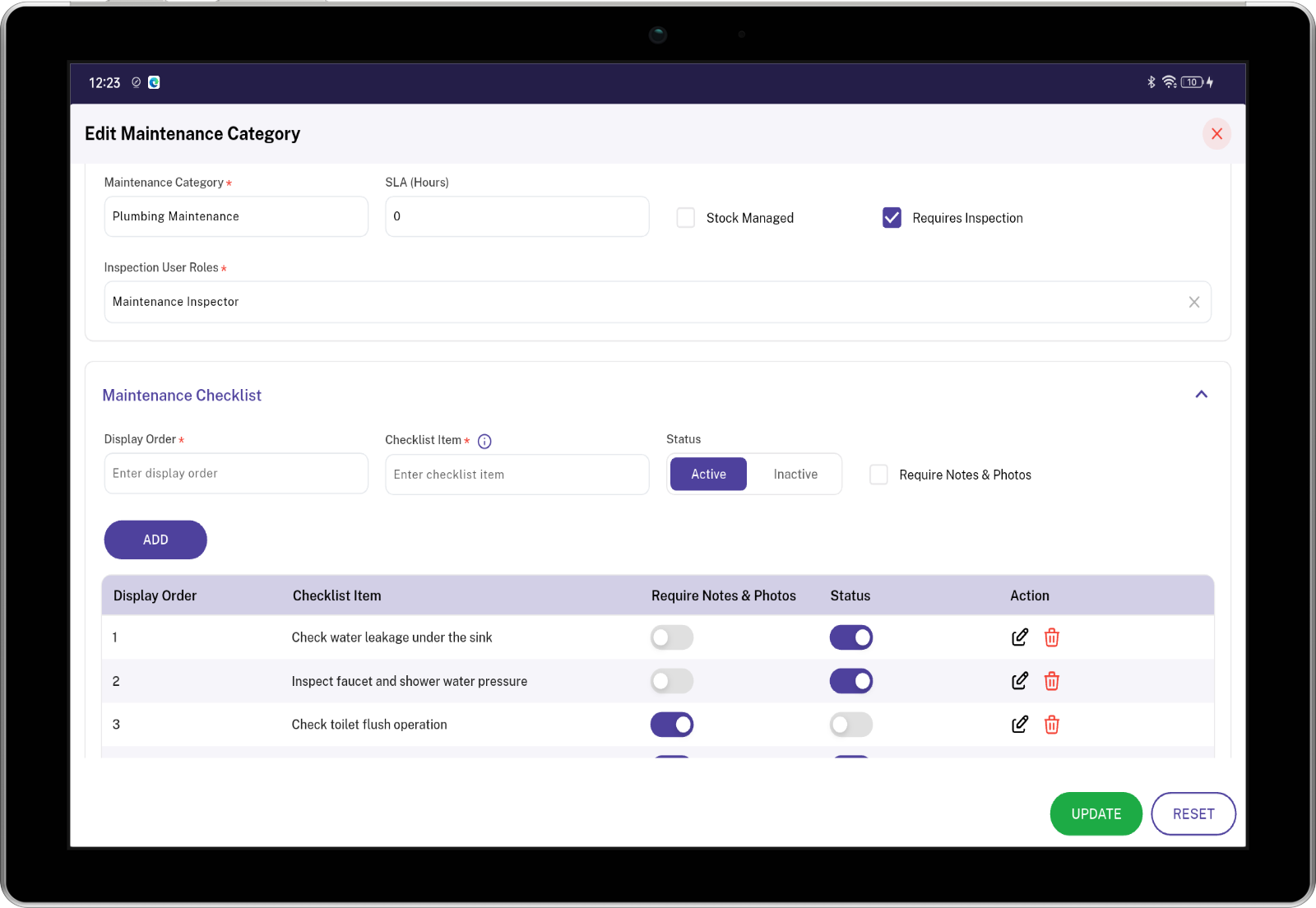
Saving a name that already exists at this property is rejected.
What is copied onto a work order
Creating a work order takes a snapshot of the category at that moment:
- the category name
- whether inspection is required
- the SLA hours
- whether stock is managed
- the inspection roles
- every active checklist step
The due time on the work order is the reported time plus the SLA hours. Zero hours means there is no due time.
Changing or removing a category later
| What you change | What happens to work orders |
|---|---|
| The category name | The name updates on work orders that already use this category. |
| SLA, inspection, roles, stock, or the checklist | Work orders already created keep the snapshot they received. They do not pick up the new setup. |
| The category on a work order that is still Reported or Assigned | That work order takes a fresh snapshot from the category you pick, including a new checklist. |
| The category on a work order after work has started | The change is rejected. |
| Delete | Allowed only when no work order uses the category. A built-in system category hides Delete. |
An inactive category remains on old work orders and no longer appears when someone creates a new one.
How this affects the floor
Write the steps in the order the job is actually done. On the board, the technician or inspector can mark only the next open step.
- Turn on Require Notes & Photos for any step that needs proof. That step cannot be completed with an empty note and no photo.
- Turn on Requires Inspection when the room or area should be checked before the work order closes. Choose roles that real inspectors have. With inspection on and no matching role, nobody on the floor can start the inspection.
- SLA (Hours) is the time promise. The board marks the work order late when the finish time, or the current time if it is still open, is past the due time.