Task Management
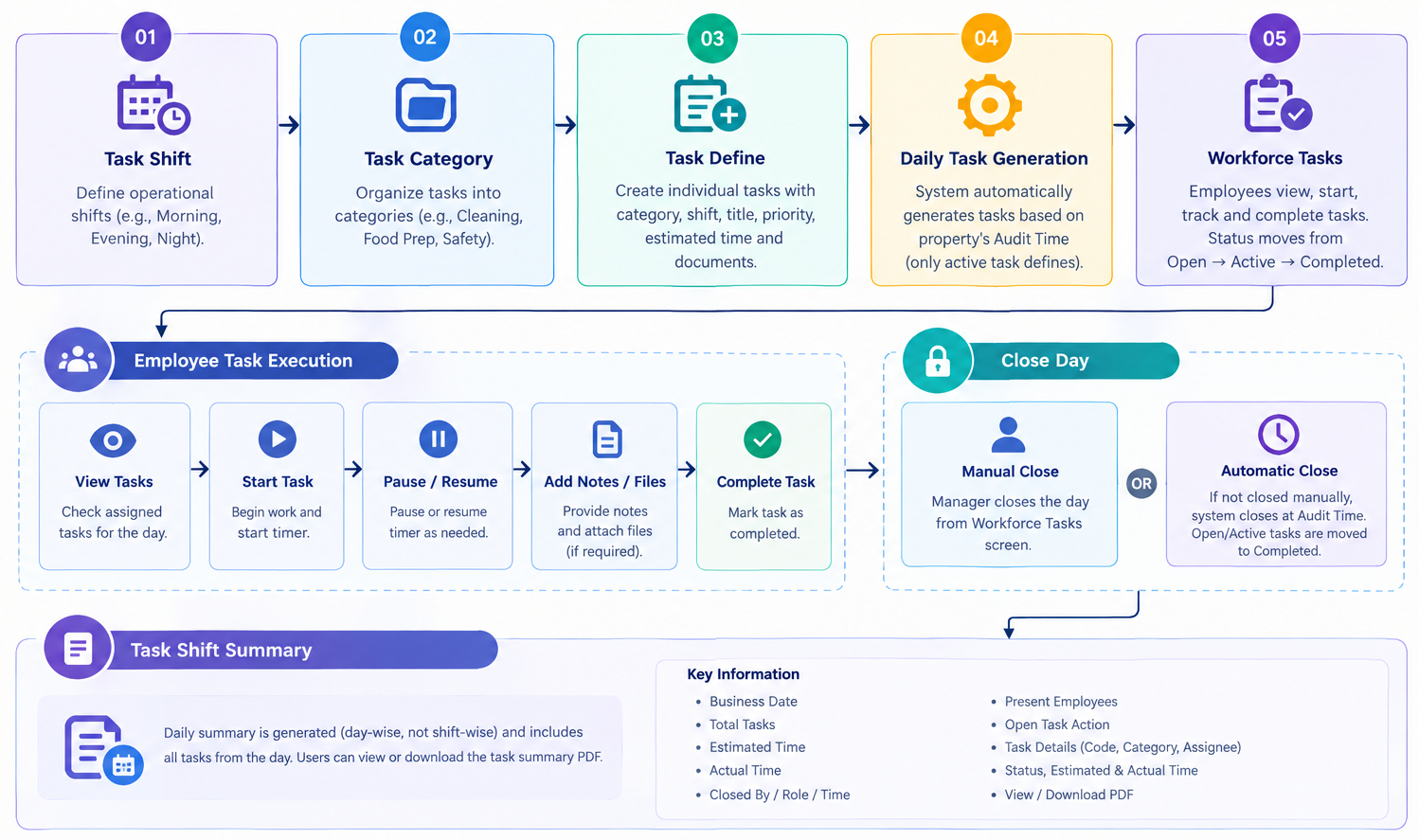
The Task Management module helps managers and employees organize, manage, and complete daily operational tasks. Managers configure task shifts, categories, and task definitions, while the system automatically generates daily tasks based on active task definitions and the property's Audit Time. Employees complete the generated tasks through Workforce Tasks, and the day's activity is finalized and available in the Task Shift Summary.
Overview
The Task Management module helps managers and employees organize, assign, complete, and monitor daily operational tasks within a property.
Managers can configure task shifts, categories, and task definitions. The system then generates daily tasks based on the property's configured Audit Time. Employees can view and complete these tasks through Workforce Tasks.
The module also provides a Task Shift Summary to review the completed tasks for each business day.
Task Management Pages
1. Task Shift
Task Shift is used to define the shifts in which Workforce Tasks are performed.
Managers can configure the shift name, color, display order, and active status.
2. Task Category
Task Category is used to organize Workforce Tasks into different operational categories.
Examples include Cleaning, Food Preparation, Safety & Compliance, and Quality Assurance.
3. Task Define
Task Define is used to create and configure individual tasks.
A task can be linked to a category and shift with a title, description, priority, estimated duration, and optional document.
Only active Task Define records are used for daily task generation.
4. Workforce Tasks
Workforce Tasks is where employees and managers view and manage the daily tasks generated by the system.
Tasks move through the following status:
Open → Active → Completed
Employees can start tasks, track time, add notes or attachments, and complete their assigned work.
5. Task Shift Summary
Task Shift Summary provides a day-wise summary of Workforce Tasks that were completed and closed.
The summary contains the tasks from all configured shifts for the business day and provides access to the generated Task PDF.
Task Management Workflow
Task Shift
Overview
The Task Shift feature allows administrators to define and manage shifts used for Workforce Tasks within the property.
Task shifts help organize workforce tasks according to the employee's working period, such as Morning, Evening Shift, or Night Shift.
Each task shift can be configured with a shift name, color, display order, and active status. The configured shifts can then be used when managing and assigning workforce tasks.
Task Shift Screen
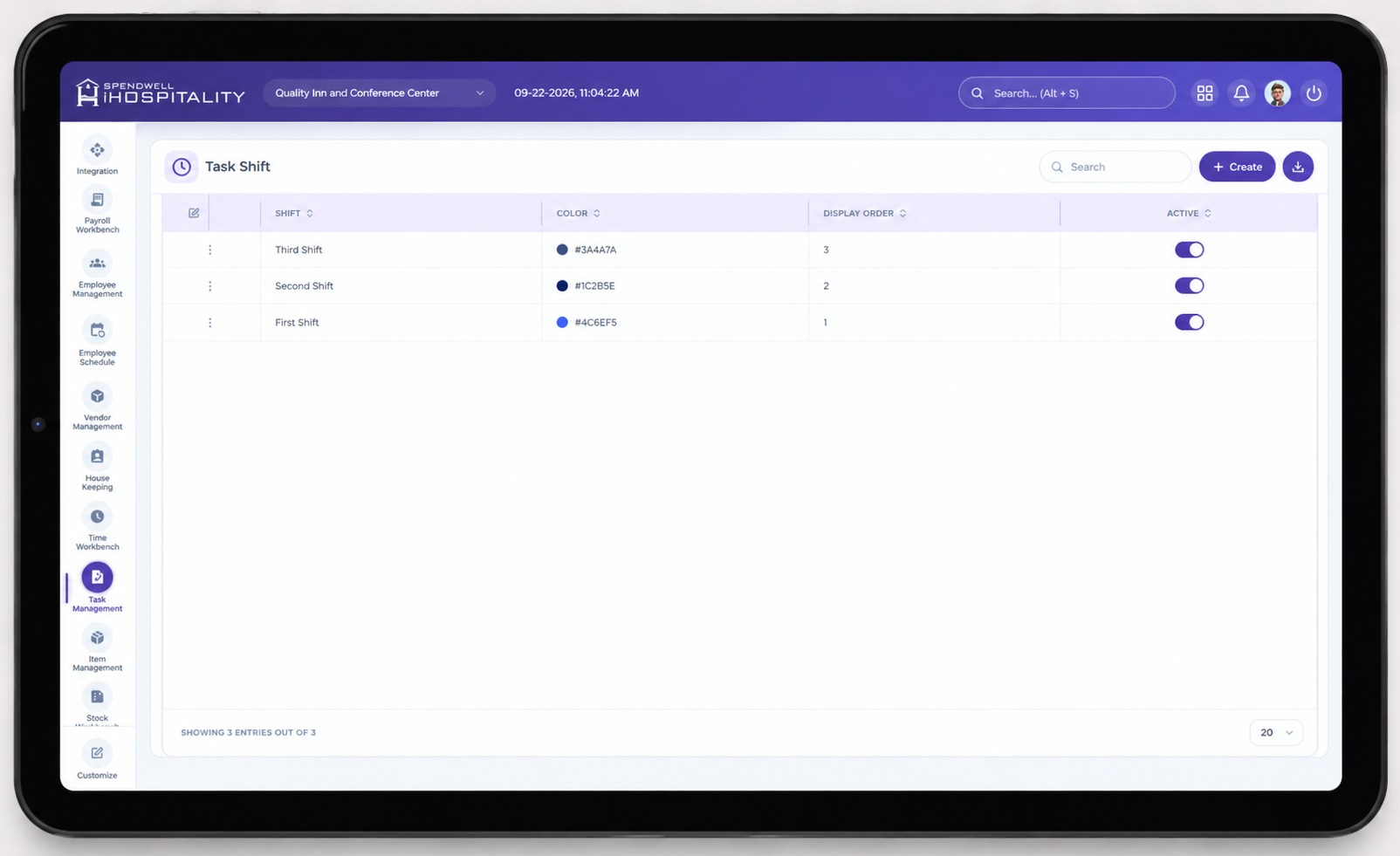
The Task Shift screen displays all configured task shifts along with their assigned color, display order, and active status.
The screen provides the following information:
- Shift — Displays the name of the configured task shift.
- Color — Displays the color assigned to the shift for visual identification.
- Display Order — Defines the order in which task shifts are displayed.
- Active — Indicates whether the task shift is currently active and available for use.
Administrators can create a new task shift using the Create button.
Add Task Shift
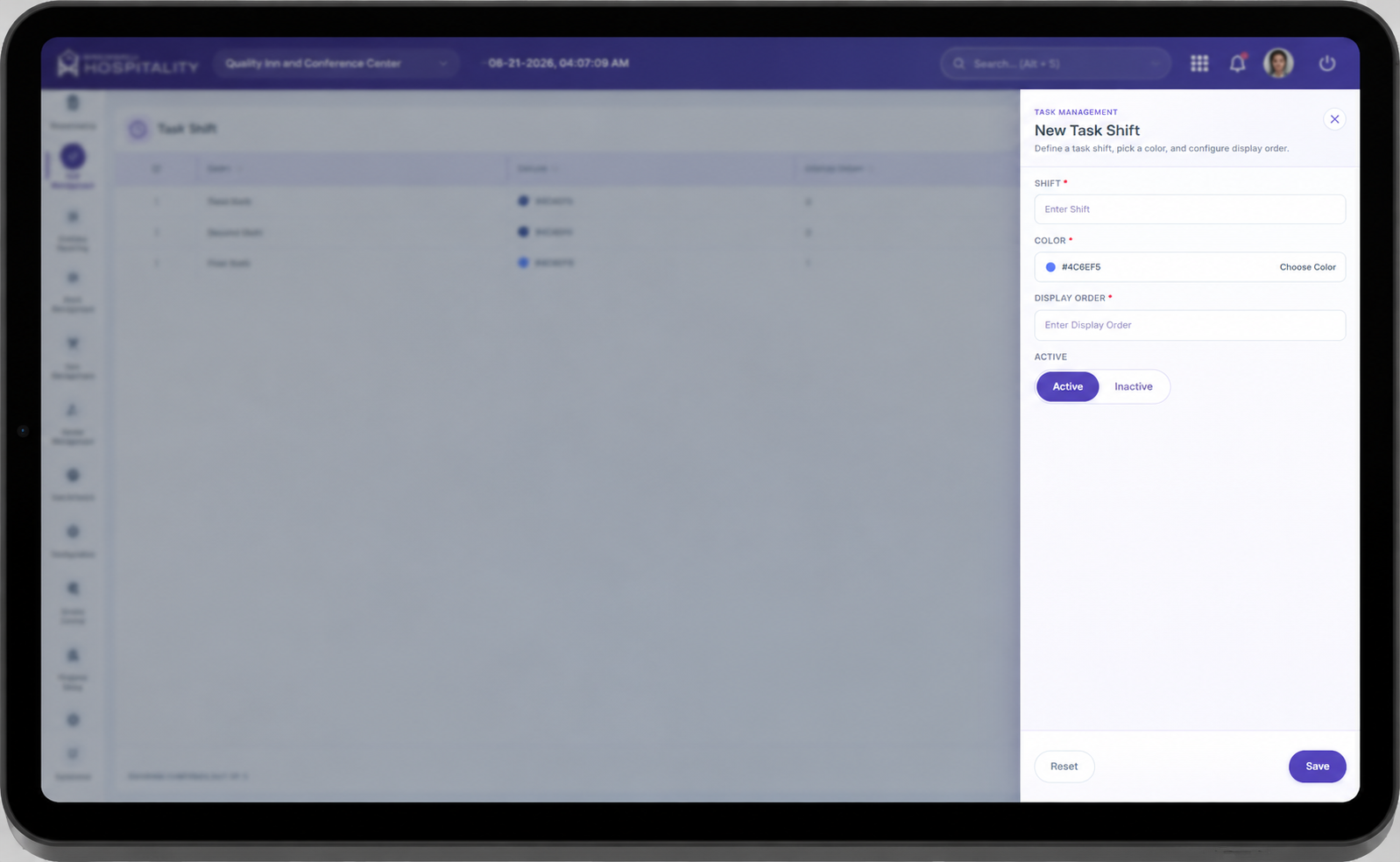
When the administrator clicks the Create button, the Add Task Shift panel opens on the right side of the screen.
The panel allows the administrator to configure a new task shift using the following fields:
- Shift
- Color
- Display Order
All fields marked with an asterisk (*) are required.
Key Fields
- Shift — Name of the task shift being created, such as Morning, Evening Shift, or Night Shift.
- Color — Color assigned to the task shift. The selected color helps users visually identify the shift within Workforce Tasks.
- Display Order — Determines the order in which task shifts are displayed.
- Active — Indicates whether the task shift is active and available for use.
- Save — Saves the task shift with the configured information.
- Save & Add New — Saves the current task shift and keeps the panel open so another task shift can be created.
- Reset — Clears the entered information without saving the task shift.
- Create — Opens the Add Task Shift panel for creating a new task shift.
- Close (X) — Closes the Add Task Shift panel without saving the current entry.
Steps
Create a New Task Shift
Manage Task Shift Status
- Locate the required task shift in the Task Shift list.
- Review the configured Shift, Color, and Display Order.
- Use the Active toggle to enable or disable the task shift.
- An active task shift is available for use in Workforce Tasks.
- An inactive task shift is not available for new task operations while the master record remains configured.
Example Task Shifts
| Shift | Color | Display Order | Status |
|---|---|---|---|
| Morning | #69DA20 |
1 | Active |
| Evening Shift | #3C3489 |
2 | Active |
| Night Shift | #72243E |
3 | Active |
Important Notes
- Shift, Color, and Display Order are required fields when creating a task shift.
- The Shift name should clearly identify the working period or operational shift.
- Use meaningful and consistent shift names across the property.
- The Color helps users quickly identify different shifts within Workforce Tasks.
- Display Order controls the sequence in which task shifts are presented.
- Use unique display order values to maintain a consistent shift sequence.
- Only active task shifts should be used for current Workforce Task operations.
- Deactivating a task shift makes it unavailable for new task operations without requiring the master record to be deleted.
- Properties can configure task shifts according to their operational requirements.
- Common task shifts may include Morning, Evening Shift, and Night Shift.
- Review the shift name, color, display order, and active status before saving the configuration.
Task Category
Overview
The Task Category feature allows administrators to define and manage categories used to organize Workforce Tasks within the property.
Task categories help group tasks based on their operational purpose or department activity, such as Cleaning, Quality Assurance, Waste Management, Food Preparation, Plating & Serving, Cleaning & Sanitization, and Safety & Compliance.
Each task category can be configured with a category name, color, display order, and active status. These categories help users quickly identify and organize workforce tasks throughout the system.
Task Category is a single-screen master feature — existing task categories are displayed in a list, and new categories can be created from the same screen.
Task Category Screen
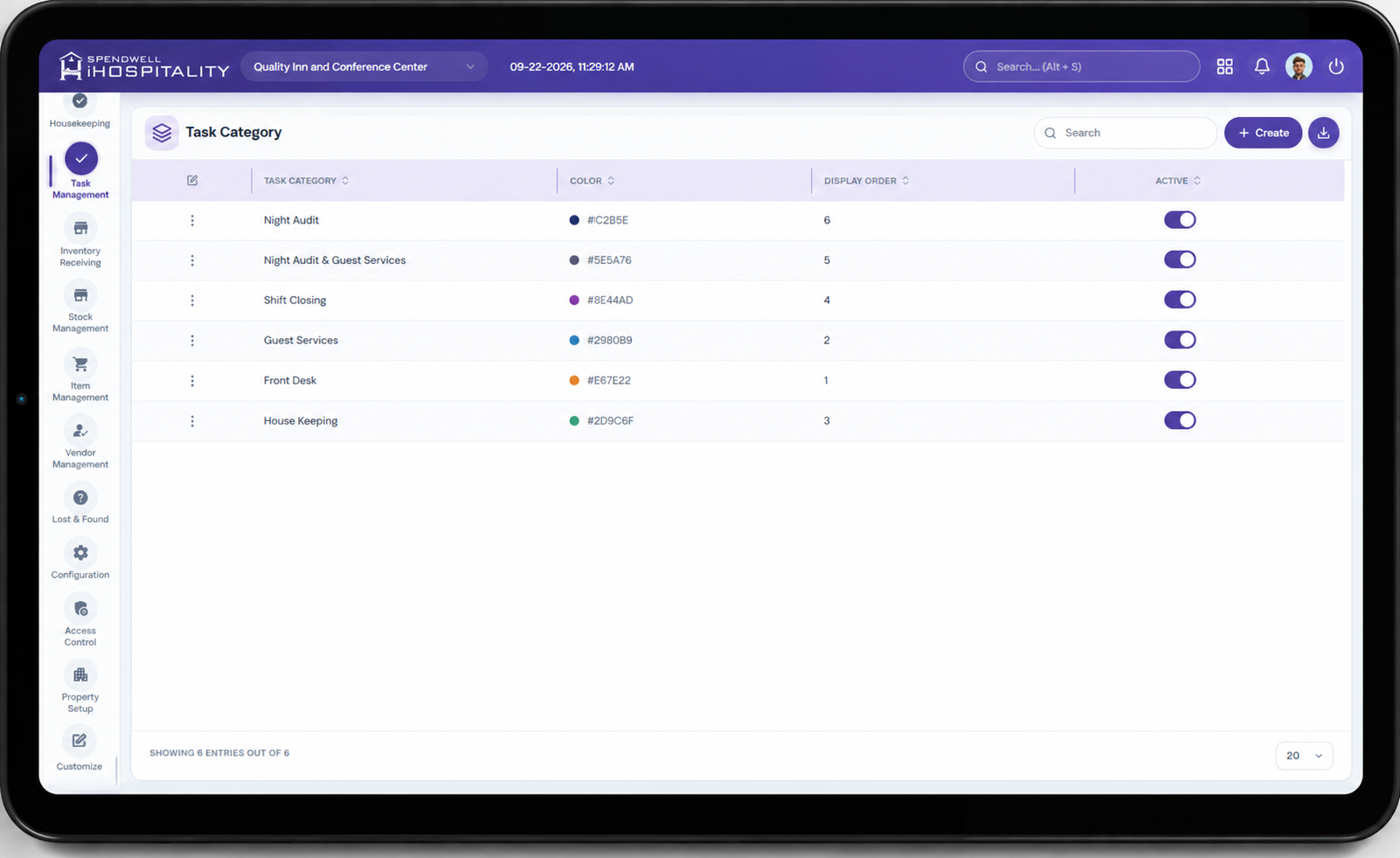
The Task Category screen displays all configured task categories along with their assigned color, display order, and active status.
The screen provides the following information:
- Task Category — Displays the name of the configured task category.
- Color — Displays the color assigned to the category for visual identification.
- Display Order — Defines the order in which task categories are displayed.
- Active — Indicates whether the task category is currently active and available for use.
Administrators can create a new task category using the Create button.
Add Task Category
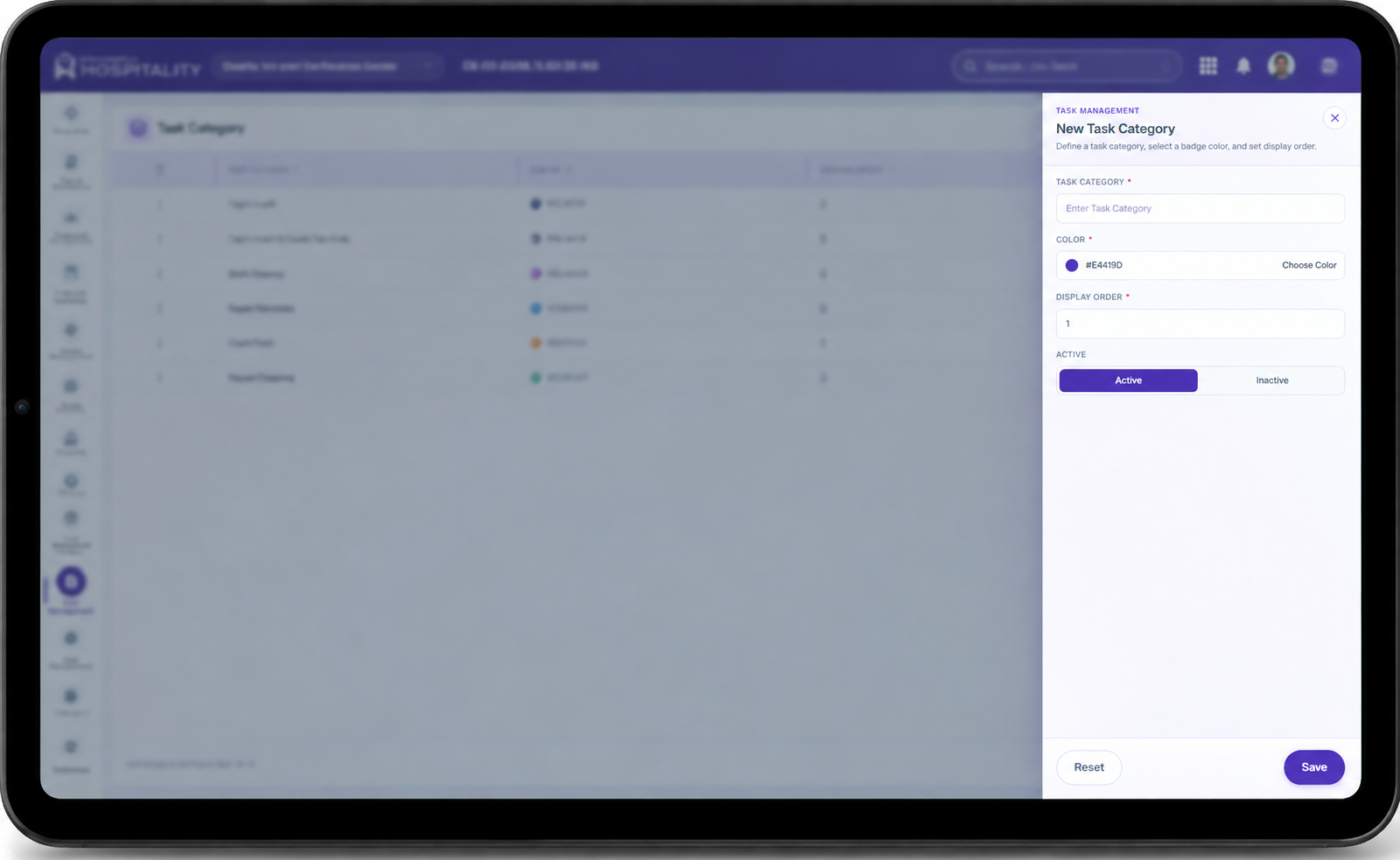
When the administrator clicks the Create button, the Add Task Category panel opens on the right side of the screen.
The panel allows the administrator to configure a new task category using the following fields:
- Task Category
- Color
- Display Order
All fields marked with an asterisk (*) are required.
Key Fields
- Task Category — Name of the task category being created, such as Cleaning, Quality Assurance, Food Preparation, or Safety & Compliance.
- Color — Color assigned to the task category. The selected color helps users visually identify the category within Workforce Tasks.
- Display Order — Determines the order in which task categories are displayed.
- Active — Indicates whether the task category is active and available for use.
- Save — Saves the task category with the configured information.
- Save & Add New — Saves the current task category and keeps the panel open so another category can be created.
- Reset — Clears the entered information without saving the task category.
- Create — Opens the Add Task Category panel for creating a new task category.
- Close (X) — Closes the Add Task Category panel without saving the current entry.
Steps
Create a New Task Category
Manage Task Category Status
- Locate the required task category in the Task Category list.
- Review the configured Task Category, Color, and Display Order.
- Use the Active toggle to enable or disable the task category.
- An active task category is available for use in Workforce Tasks.
- An inactive task category is not available for new task operations while the master record remains configured.
Example Task Categories
| Task Category | Color | Display Order | Status |
|---|---|---|---|
| Cleaning | #4896BE |
1 | Active |
| Quality Assurance | #3C3489 |
2 | Active |
| Waste Management | #84CC16 |
3 | Inactive |
| Food Preparation | #633806 |
4 | Active |
| Plating & Serving | #0C447C |
5 | Active |
| Cleaning & Sanitization | #4A1B0C |
6 | Active |
| Safety & Compliance | #DC2626 |
7 | Active |
Important Notes
- Task Category, Color, and Display Order are required fields when creating a task category.
- The task category name should clearly describe the type of work or operational activity.
- Use meaningful and consistent category names across the property.
- The Color helps users quickly identify different task categories within Workforce Tasks.
- Display Order controls the sequence in which task categories are presented.
- Use unique display order values to maintain a consistent category sequence.
- Only active task categories should be used for current Workforce Task operations.
- Deactivating a task category makes it unavailable for new task operations without requiring the master record to be deleted.
- Properties can configure task categories according to their operational requirements.
- Common task categories may include Cleaning, Quality Assurance, Food Preparation, Plating & Serving, Cleaning & Sanitization, and Safety & Compliance.
- Review the category name, color, display order, and active status before saving the configuration.
Task Define
Overview
The Task Define feature allows administrators to define and manage the individual tasks that are performed as part of Workforce Task operations within the property.
A task definition connects a Task Category with a Task Shift and provides the task details, priority, and estimated duration. This allows properties to create standardized tasks that can be assigned and managed by employees based on operational requirements.
Each task definition can include a Task Category, Task Shift, Task Title, Task Description, Priority, estimated duration, and an optional Document.
Task Define is a single-screen feature — existing task definitions are displayed in a list, and new tasks can be created from the same screen.
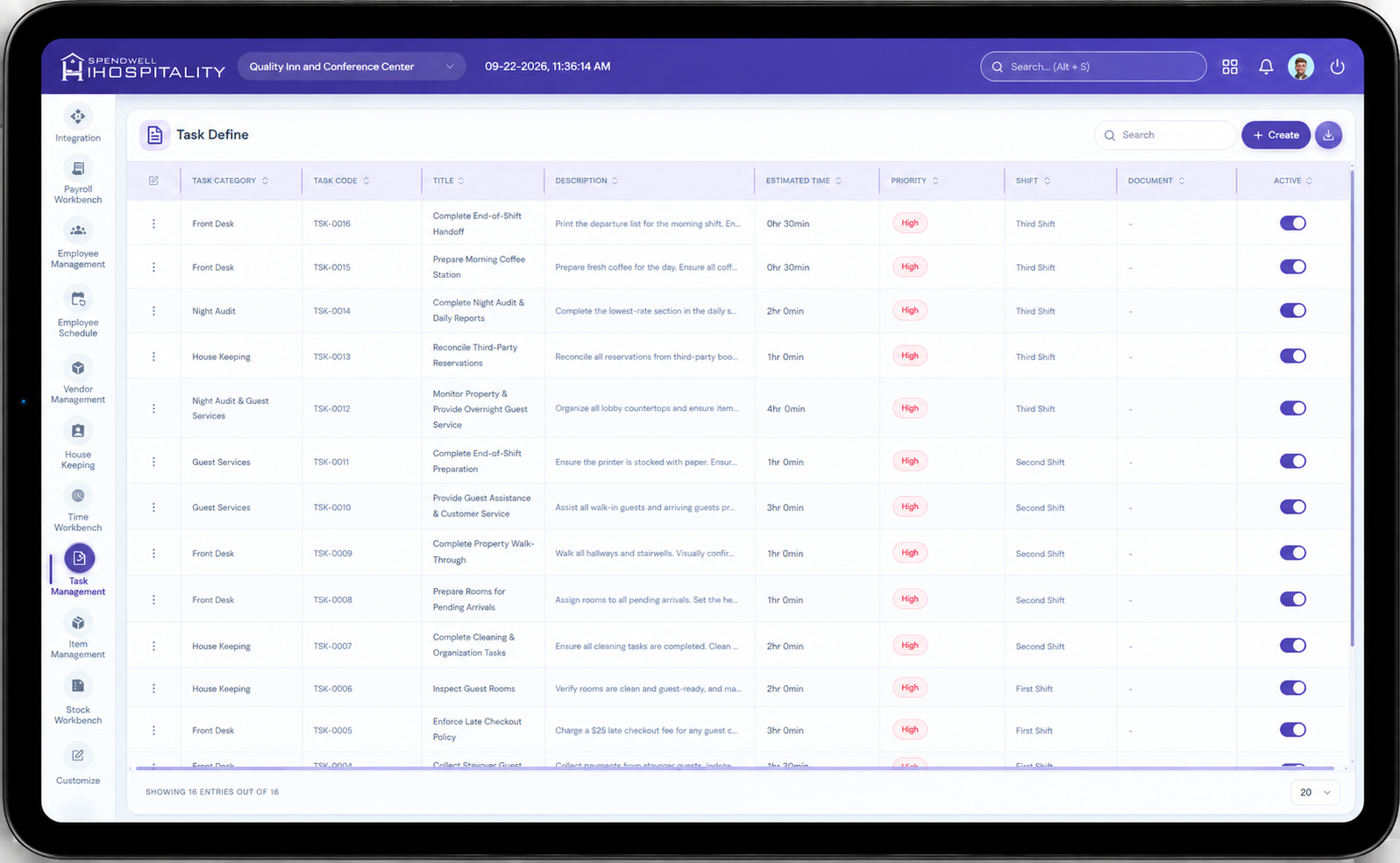
Task Define Screen
The Task Define screen displays all configured workforce task definitions.
The screen provides the following information:
- Task Category — Displays the category associated with the task.
- Shift — Displays the shift during which the task is intended to be performed.
- Title — Displays the name of the task.
- Task Code — Displays the unique system-generated code assigned to the task.
- Description — Provides details about what needs to be completed for the task.
- Priority — Indicates the importance or urgency of the task.
Administrators can create a new task definition using the Create button.
Add Task Define
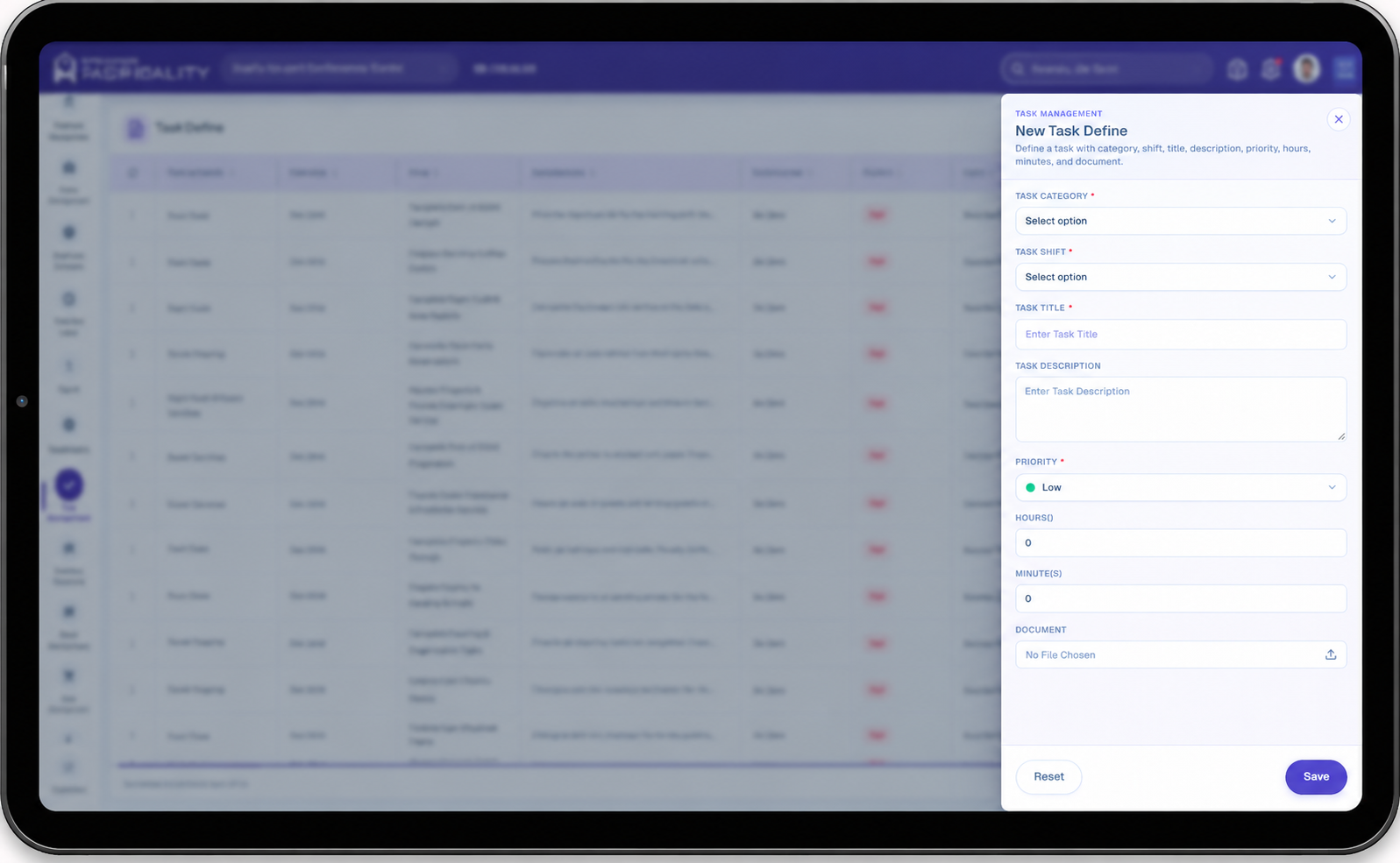
When the administrator clicks the Create button, the Add Task Define panel opens on the right side of the screen.
The panel allows the administrator to configure a new workforce task using the following fields:
- Task Category
- Task Shift
- Task Title
- Task Description
- Priority
- Hour(s)
- Minute(s)
- Document
Fields marked with an asterisk (*) are required.
Key Fields
- Task Category — Required field used to associate the task with a configured task category, such as Cleaning, Quality Assurance, Food Preparation, or Safety & Compliance.
- Task Shift — Required field used to associate the task with a configured shift, such as Morning, Evening Shift, or Night Shift.
- Task Title — Required field containing the name of the task, such as Utensil Deep Cleaning, Weekly Inventory Count, or Service Readiness Check.
- Task Description — Optional field used to provide detailed instructions or additional information about the task.
- Priority — Required field used to define the importance of the task. For example, Low, Medium, or High.
- Hour(s) — Defines the estimated number of hours required to complete the task.
- Minute(s) — Defines the estimated number of additional minutes required to complete the task.
- Document — Optional field that allows an administrator to attach a supporting document or reference file related to the task.
- Task Code — A unique task identifier displayed in the Task Define list. The system assigns the task code when the task is created.
- Save — Saves the task definition with the configured information.
- Save & Add New — Saves the current task definition and keeps the panel open so another task can be created.
- Reset — Clears the entered information without saving the task.
- Create — Opens the Add Task Define panel for creating a new task.
- Close (X) — Closes the Add Task Define panel without saving the current entry.
Task Duration
The Hour(s) and Minute(s) fields are used to define the expected duration of a task.
For example:
| Hour(s) | Minute(s) | Estimated Duration |
|---|---|---|
| 0 | 15 | 15 minutes |
| 0 | 30 | 30 minutes |
| 1 | 0 | 1 hour |
| 1 | 30 | 1 hour 30 minutes |
| 2 | 0 | 2 hours |
This duration can help employees and managers understand the expected time required to complete the task.
Steps
Create a New Task Definition
Task Definition Components
A task definition is made up of the following primary components:
Task Category → Task Shift → Task Title → Task Description → Priority → Duration → Document
- Task Category identifies the type of work.
- Task Shift identifies the operational shift for the task.
- Task Title identifies the specific activity to be completed.
- Task Description provides instructions or additional details.
- Priority indicates the importance of completing the task.
- Duration defines the expected time required to complete the task.
- Document provides an optional reference or supporting file.
Important Notes
- Task Category, Task Shift, Task Title, and Priority are required fields when creating a task definition.
- Task Category must be selected from the configured Task Category master.
- Task Shift must be selected from the configured Task Shift master.
- Use clear and action-oriented Task Titles so employees can easily understand the required activity.
- The Task Description should provide sufficient instructions when the task requires additional clarification.
- Set the Priority according to the operational importance of the task.
- Use Hour(s) and Minute(s) to define the expected completion time.
- A supporting Document can be attached when employees need additional instructions, procedures, checklists, or reference material.
- The system assigns a unique Task Code to each task definition.
- Task definitions should be reviewed regularly to ensure that task descriptions, priorities, durations, and supporting documents remain accurate.
- Only appropriate and active Task Categories and Task Shifts should be used when configuring new task definitions.
- Use Save & Add New when multiple task definitions need to be created consecutively.
- Review all task information before clicking Save to ensure the task is configured correctly.
Workforce Tasks
Overview
The Workforce Tasks module on the iHospitality Hub lets employees view, work on, and track the tasks assigned to their shift — organized by Task Category and Task Shift, and tracked through Open → Active → Completed.
Workforce Tasks are generated automatically based on the property's configured Audit Time. The system uses the active task definitions configured in the Task Define master to create the daily tasks.
Employees can start a live timer on a task, pause or stop the timer, add notes and attachments, assign or reassign tasks, and complete the assigned work. Managers can review task activity and close the day once the day's task operations are finalized.
This module only appears on hubs where Workforce Tasks was checked under Hub Modules, and only for employees whose User Role has Can iHospitality Hub Login enabled — see the iHospitality Hub – Setup page.
Daily Task Generation
Workforce Tasks are automatically generated on a daily basis according to the property's configured Audit Time.
The system uses the Task Define master as the source for generating daily tasks.
Only active Task Define records are considered for automatic task generation.
The daily task generation process uses the following configuration:
- Task Category — Determines the category assigned to the generated task.
- Task Shift — Determines the shift associated with the generated task.
- Task Title — Defines the task that employees need to perform.
- Task Description — Provides instructions or additional information for the task.
- Priority — Determines the priority of the generated task.
- Hour(s) / Minute(s) — Defines the estimated duration of the task.
- Active Status — Determines whether the task definition should be included in daily task generation.
- Property Audit Time — Determines the property's daily operational/audit boundary used for generating the day's workforce tasks.
Automatic Task Generation Flow
The daily task generation follows this process:
Property Audit Time → System generates daily Workforce Tasks → Active Task Define records are selected → Tasks are created for the applicable shift/category → Employees work on the generated tasks
For example, if a property has the following active Task Define:
| Task Category | Task Shift | Task Title | Priority | Status |
|---|---|---|---|---|
| Cleaning | Morning | Lobby Cleaning | High | Active |
| Quality Assurance | Evening Shift | Kitchen Equipment Sanitization | High | Active |
| Safety & Compliance | Night Shift | Safety Inspection | Medium | Active |
The system automatically creates the corresponding workforce task records for the applicable day based on the property's Audit Time configuration.
Important: A Task Define must be Active to participate in automatic daily task generation. Inactive Task Define records are not automatically added to Workforce Tasks.
Task Define and Daily Task Generation
The Task Define master controls which tasks are automatically generated for Workforce Tasks.
Administrators can create and maintain task definitions from the Task Define master.
A Task Define contains information such as:
- Task Category
- Task Shift
- Task Title
- Task Description
- Priority
- Estimated Hours
- Estimated Minutes
- Supporting Document
- Active Status
When the daily task generation process runs, the system evaluates the configured Task Define records.
Active Task Define
If a Task Define is Active, it is eligible for automatic daily task generation.
Inactive Task Define
If a Task Define is Inactive, the system does not generate a new daily Workforce Task from that definition.
This allows administrators to temporarily stop a task from being generated without deleting the Task Define configuration.
Property Audit Time
The property's Audit Time configuration determines the daily operational boundary used by the Workforce Tasks process.
The system uses the configured property Audit Time when determining the daily task generation cycle.
For example:
- Property Audit Time: 02:00 AM
- The daily operational cycle is based on the configured audit boundary.
- Active Task Define records are used to generate the applicable Workforce Tasks for that operational day.
The exact task generation date and operational day should be interpreted according to the property's configured Audit Time and timezone.
Workforce Tasks Screen (Board View)
After signing in and tapping Workforce Tasks, the employee sees a board of tasks for the selected date, shift, and category.
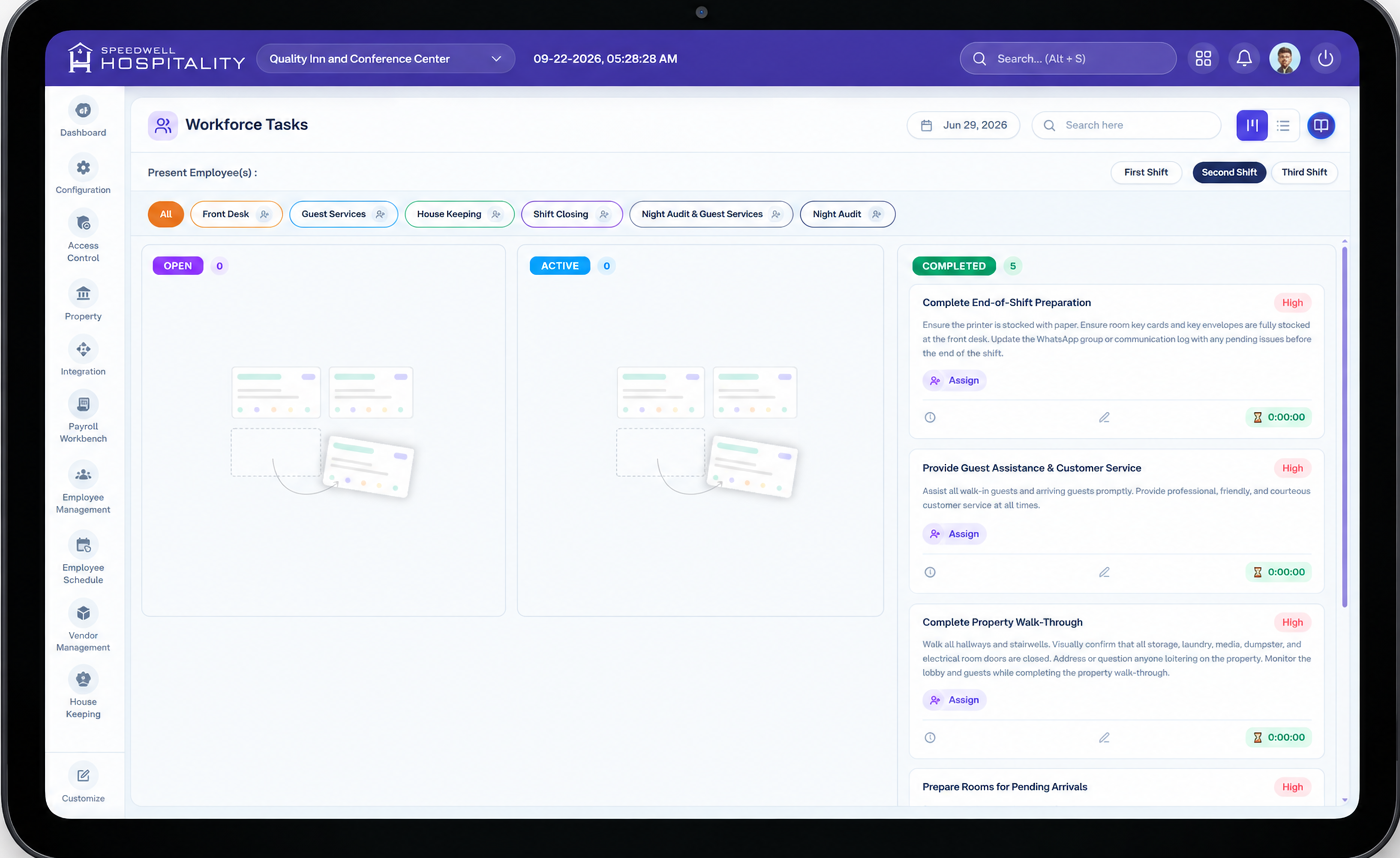
What this screen means: this is the default board view — tasks are grouped into three columns by status, and can be filtered by shift and category using the controls above the board. Click any screenshot on this page to open it full-screen.
Key Information
| Element | Description |
|---|---|
| **Date picker** | Selects which day's tasks are shown (defaults to today). |
| **Search** | Searches tasks by name. |
| **View toggle** | Switches between **Board view** (kanban, shown above) and **List view** (see below). |
| **Close Day (lock icon)** | Opens the Close Day confirmation — see Actions below. |
| **Present Employee(s)** | Shows the employee(s) currently on shift as avatar chips, for quick reference when assigning tasks. |
| **Shift filter** | Morning / Evening Shift / Night Shift — only tasks for the selected shift are shown. |
| **Category tabs** | Cleaning, Quality Assurance, Food Preparation, Plating & Serving, Cleaning & Sanitization, Safety & Compliance. Selecting a tab filters the board to that category's tasks; the **+ person** icon on each tab assigns an employee to that whole category. |
| **Board columns** | **OPEN**, **ACTIVE**, **COMPLETED**, each with a live count of tasks in that state. |
Task Card
Each task card shows:
| Element | Description |
|---|---|
| **Title & priority** | Task name plus a priority badge (Low / Medium / High). |
| **Description** | Optional short explanation of the task. |
| **Estimation** | Target/planned time for the task (e.g. `00:36:00`). |
| **Assignee** | Avatar showing the assigned employee's initials (e.g. "YD"). |
| **Timer** *(Active tasks only)* | Elapsed time with **Pause** and **Stop** controls once the task has been started. |
Icon row (bottom of every card):
| Icon | Action |
|---|---|
| 🕐 History | View the task's activity/status log. |
| 📎 Attachment | View files attached to the task. |
| ✏️ Edit | Opens **Notes & Attachments** (see Actions below). |
| 👤 Assign | Assign or reassign the task to a different employee. |
| → Move to next stage | Advances the task (Open → Active → Completed). |
List View
Switching to list view shows the same tasks as a table, grouped by category, with more detail visible per row.
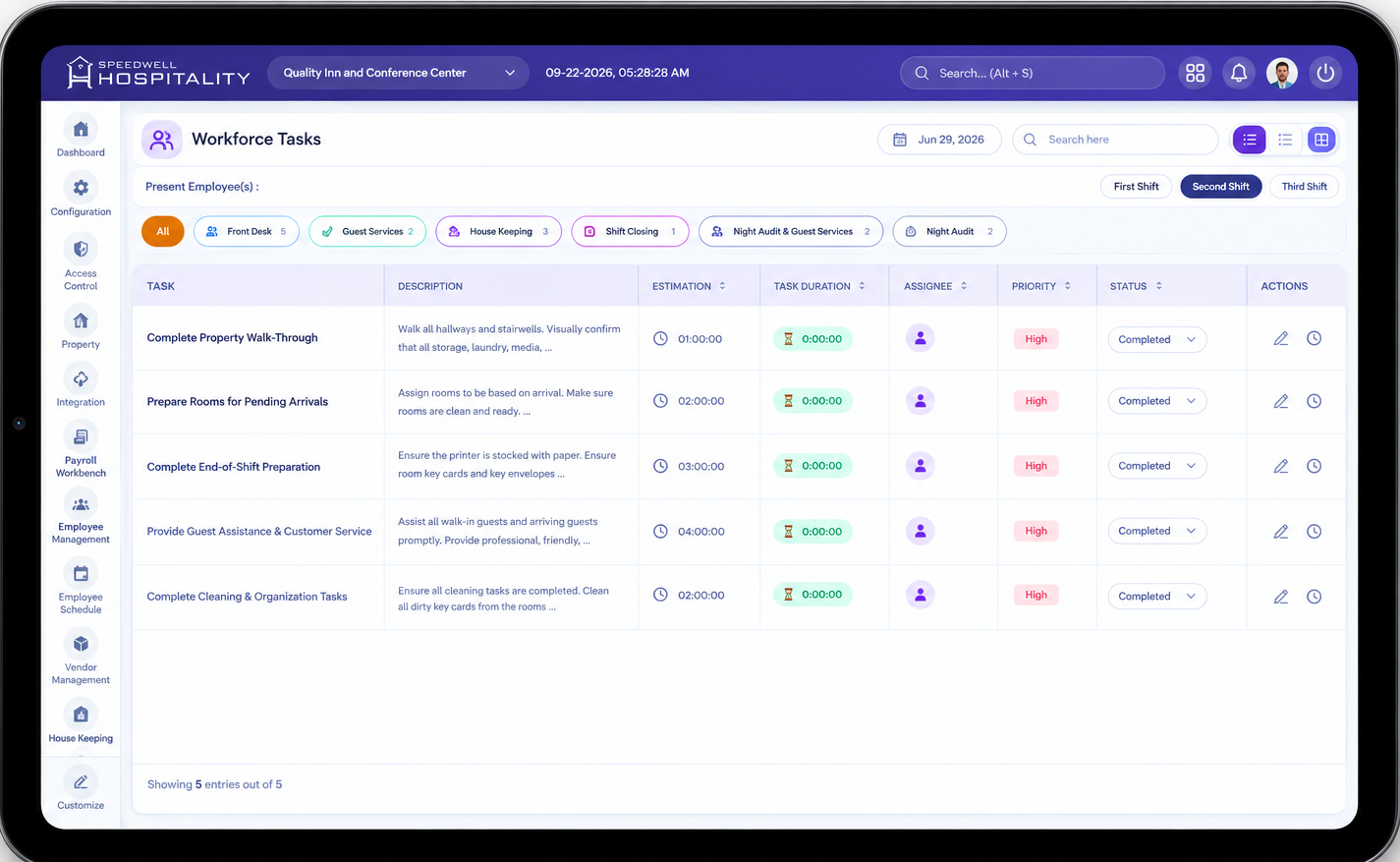
What this screen means: each category (e.g. "Quality Assurance") is an expandable group; if a category has no tasks for the selected shift, it shows "No Data Found!".
| Column | Description |
|---|---|
| **Task** | Task name. |
| **Description** | What the task involves. |
| **Estimation** | Target/planned time for the task. |
| **Task Duration** | Actual time spent — shows a live running timer with Play/Pause/Stop for an active task. |
| **Assignee** | Avatar of the employee assigned to the task. |
| **Priority** | Low / Medium / High, color-coded. |
| **Status** | Dropdown — Open / Active / Completed. Changing this here has the same effect as tapping the → arrow on the board. |
| **Document** | Attachment icon — view files attached to the task. |
| **Notes & Attachments** | Edit icon — opens the same **Notes & Attachments** form as the board view. |
| **Info** | Opens the task's full details (see Actions below). |
Actions
Start, Pause, and Stop a Task's Timer
- On the board, find the task under OPEN and tap the → arrow to move it to ACTIVE (or change its Status to Active in list view).
- Once active, a timer control appears on the card showing elapsed time, with Pause (⏸) and Stop (⏹) buttons.
- Tap Pause to temporarily stop timing without ending the task; tap again to resume.
- Tap Stop, or move the task to COMPLETED, once the work is done.
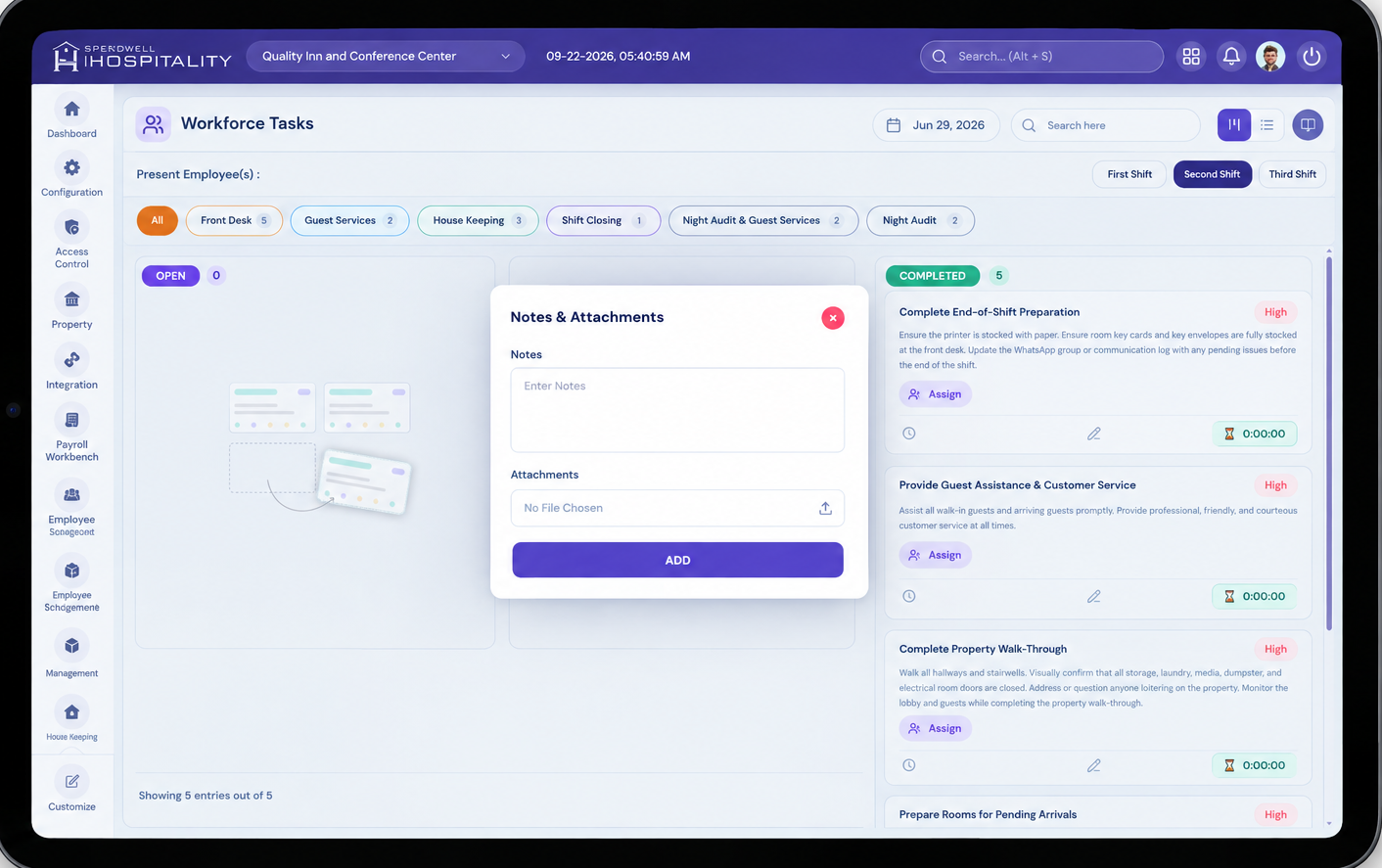
Add Notes & Attachments to a Task
-
On a task card (or its row in list view), tap the Edit icon.
-
The Notes & Attachments form opens.

What this screen means: Notes lets you add a free-text comment about the task; Attachments lets you upload a supporting file (e.g. a photo).
-
Enter a note and/or choose a file to attach.
-
Tap ADD to save it to the task.
View Task Details (Info)
-
Tap the Info icon (list view) on any task.
-
A full detail modal opens for that task — everything about it and who worked on it, in one place.

What this screen means: the header shows the task name, its ID (e.g.
BASC-00140), current stage, priority, and shift. Below that, Task Details and Task Employees show two different things — what the task is, and who actually worked on it.
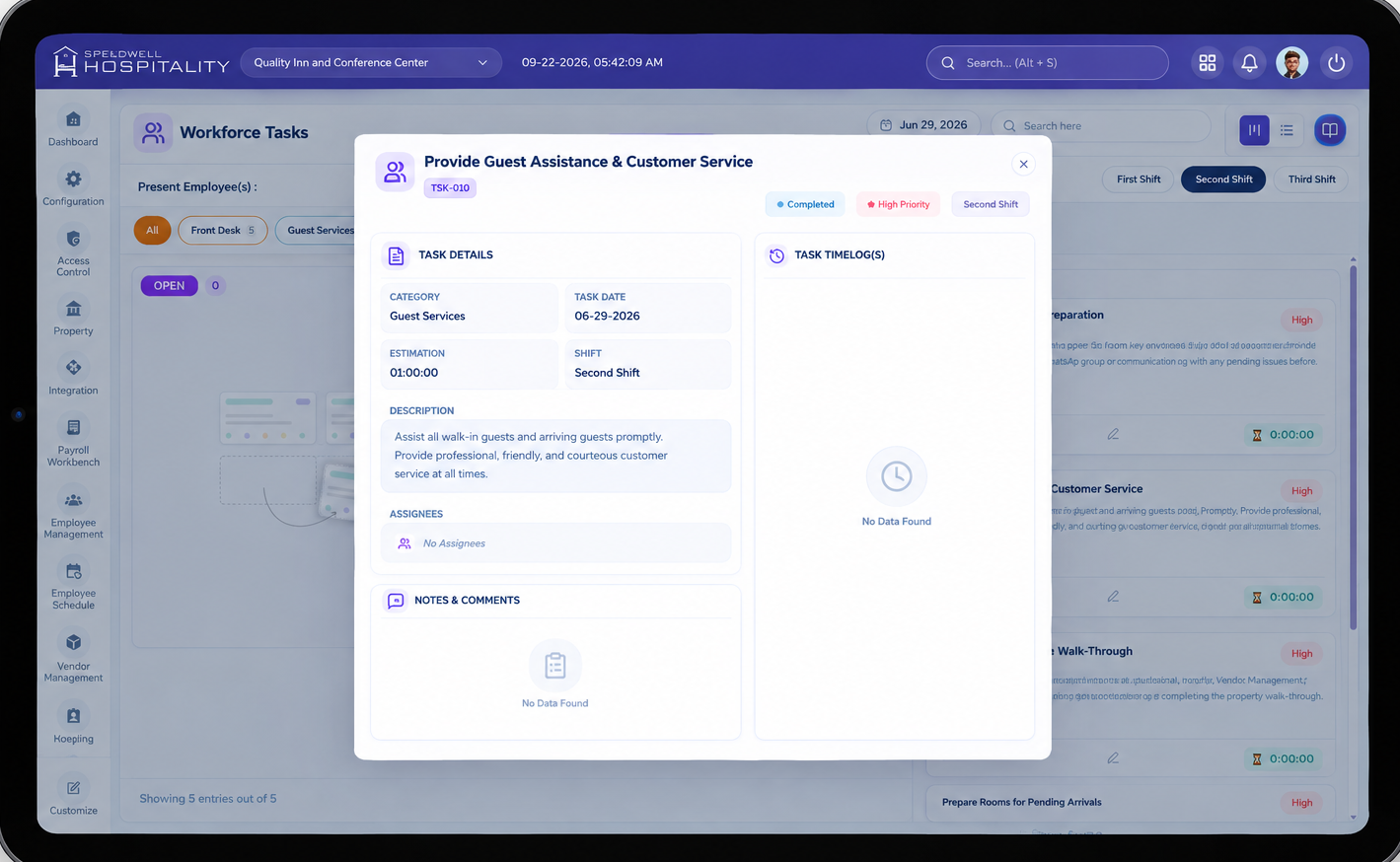
Task Details (left panel)
| Field | Description |
|---|---|
| **Task Type** | The category the task belongs to, e.g. "Quality Assurance." |
| **Due Date** | The date the task is scheduled for. |
| **Start Time / End Time** | The task's planned start and end time. |
| **Description** | What the task involves, plus its estimated duration (e.g. "80 mins"). |
| **Assigned To** | Avatar of the employee currently assigned. |
| **Notes & Attachments** | Every note/file added to this task, shown with who added it and when. |
Task Employees (right panel)
| Field | Description |
|---|---|
| **Employee name** | Who actually worked the task. |
| **Start / End** | The actual time this employee started and ended work on the task — this is real timer activity, not the planned Start/End Time on the left. |
| **Checkin / Checkout** | The date/time this employee checked in and checked out of the task. |
Assign or Reassign a Task
- On a task card, tap the person/Assign icon (or use the + person icon on a category tab to assign a whole category).
- Choose the employee to assign the task to from those present on shift.
- The task's Assignee avatar updates to reflect the new assignment.
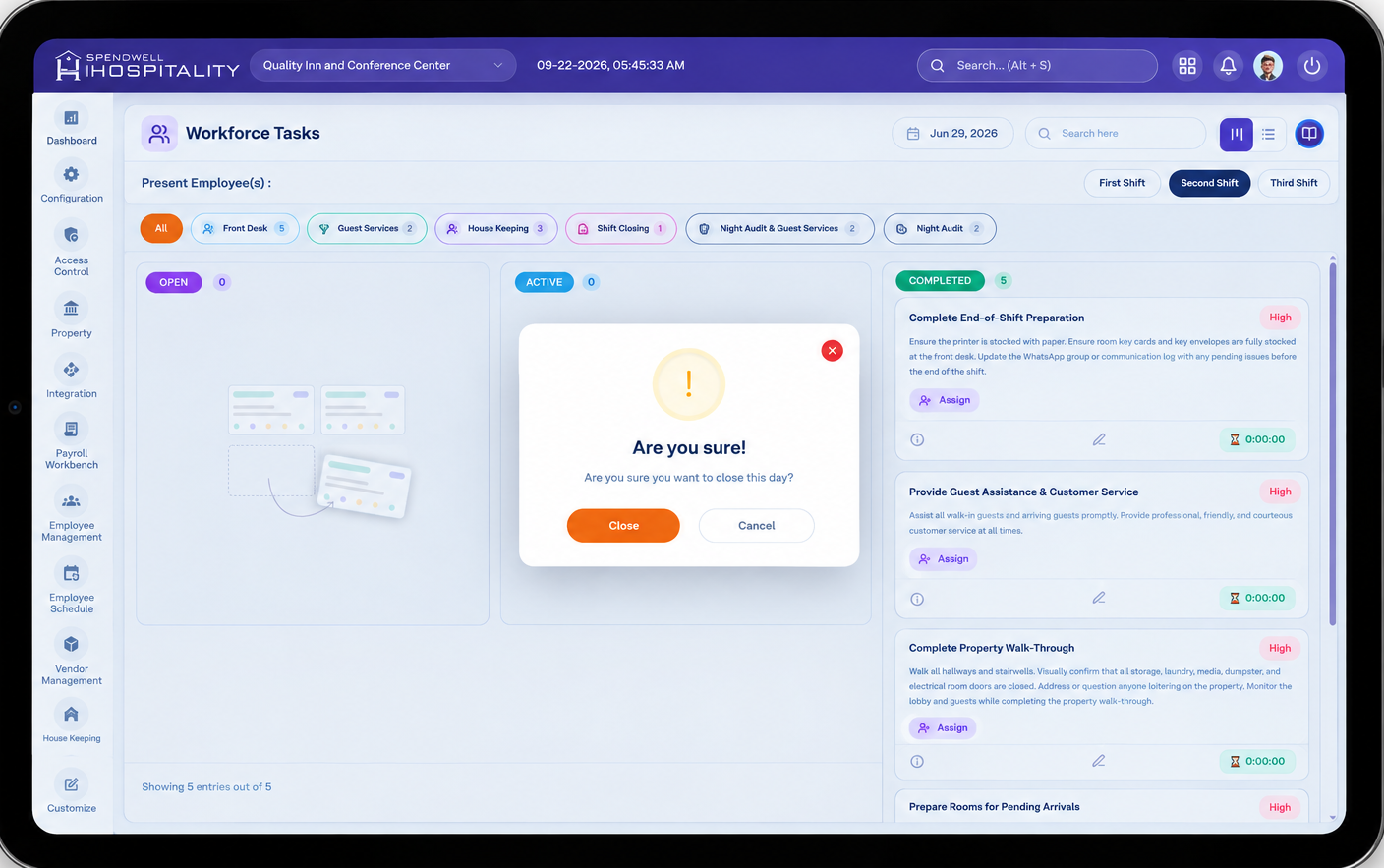
Close the Day
Once all of the shift's tasks are handled, a manager can close out the day so no further changes are made to it.
-
Tap the lock icon in the top-right of the Workforce Tasks screen.
-
A confirmation appears: "Are you sure you want to close this day?"

What this screen means: this is a safeguard against accidentally locking a day's tasks — tap CANCEL to back out, or CLOSE to finalize it.
-
Tap CLOSE to confirm, or CANCEL to go back without closing the day.
Workflow
Employee taps Workforce Tasks → Identifies via PIN/face → Selects shift & category → Task moves Open → Active (timer starts) → Pause/Resume as needed → Completed (timer stops)
To document work along the way: Task card → Edit icon → Notes & Attachments → Enter note / attach file → ADD
At end of shift: Lock icon → Are you sure? → CLOSE
Important Notes
- Moving a task's status can be done either from the board (→ arrow) or from the Status dropdown in list view — both do the same thing.
- The timer on an Active task tracks actual time spent, separately from the task's Estimation (its planned/target time) — useful for comparing planned vs. actual effort.
- Present Employee(s) only shows employees currently on shift, so assignment is limited to people actually available to do the work.
- Close Day is a safeguard action — always confirm before finalizing, since it's meant to lock in that day's task activity.
- This module only appears on hubs where Workforce Tasks was checked under Hub Modules — see the iHospitality Hub – Setup page.
Task Shift Summary
Overview
The Task Shift Summary feature provides a day-wise summary of Workforce Tasks completed and closed for a property.
The summary is generated once per business day and includes all tasks from all configured shifts for that day. It provides managers and administrators with a consolidated view of task activity, including total tasks, estimated time, actual time, employees present, and close-day information.
The system can close the task day in two ways:
- Manual Close — A manager or authorized user closes the day manually from the Workforce Tasks screen.
- Automatic Close — If the user does not close the day manually, the system automatically closes the day at the property's configured Audit Time.
When the system performs the automatic close, any Open or Active/Running tasks are automatically moved to Completed so that the day's task activity can be finalized.
Task Shift Summary Screen
The Task Shift Summary screen displays one record for each closed business day.
The summary is day-wise, not shift-wise. All tasks from the First Shift, Second Shift, Third Shift, or any other configured shifts are combined into the corresponding business day's summary.
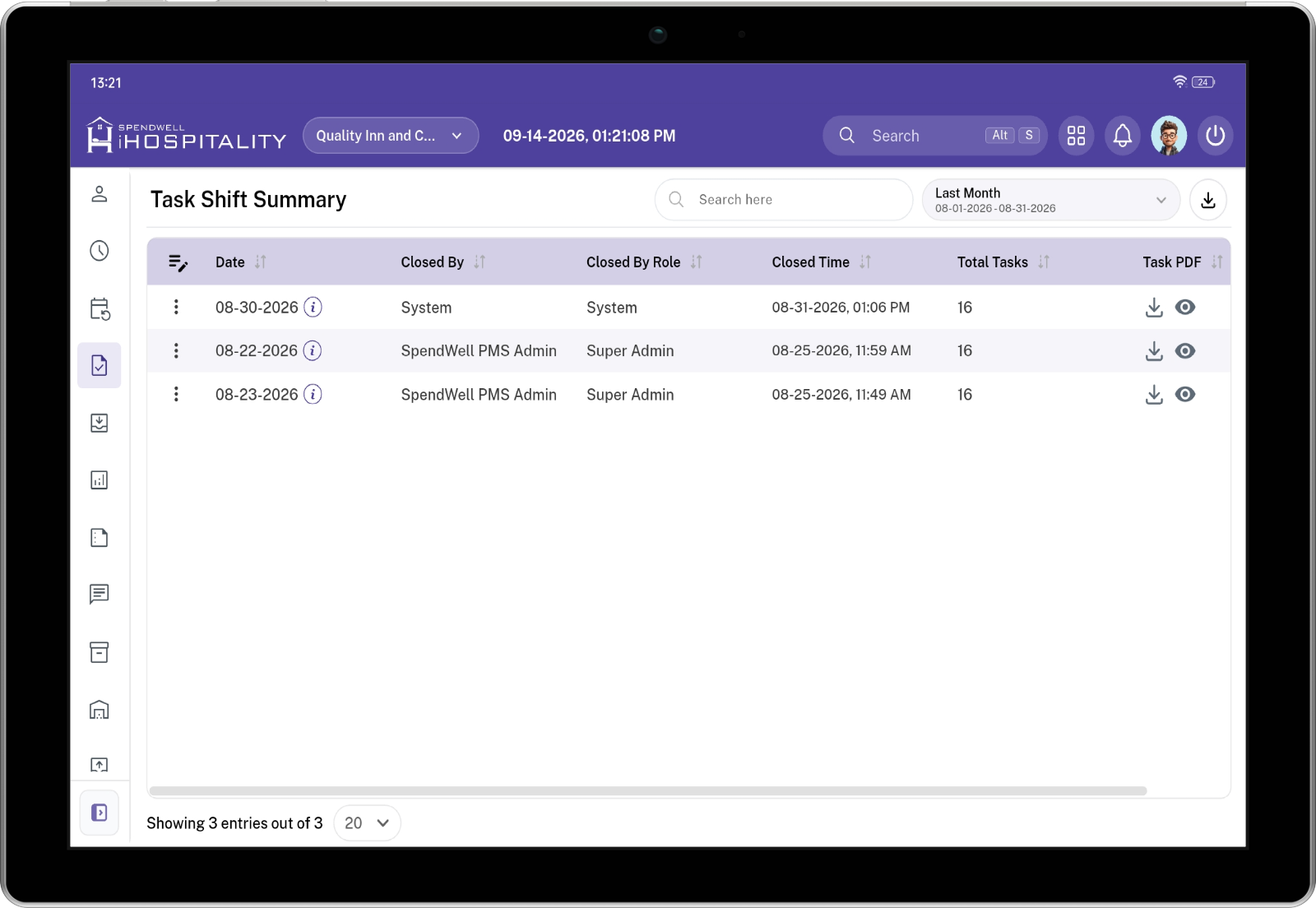
Key Information
| Column | Description |
|---|---|
| Date | Business date for which the task day was closed. |
| Closed By | User or system that closed the task day. This can be a manager/authorized user or System when the day was automatically closed. |
| Closed By Role | Role of the user who closed the day. For an automatic close, this is shown as System. |
| Closed Time | Date and time when the task day was closed. |
| Total Tasks | Total number of tasks included in the day's summary across all shifts. |
| Task PDF | Provides options to view or download the task summary PDF. |
Day-Wise Summary
Each row represents one complete business day.
For example, if a property has:
- First Shift — 6 tasks
- Second Shift — 5 tasks
- Third Shift — 5 tasks
The Task Shift Summary displays:
Total Tasks: 16
as one daily summary instead of creating separate summary records for each shift.
The PDF contains the complete task activity for that business date.
View Task Summary
The View option allows an authorized user to open the generated task summary and review the complete details for the selected business day.
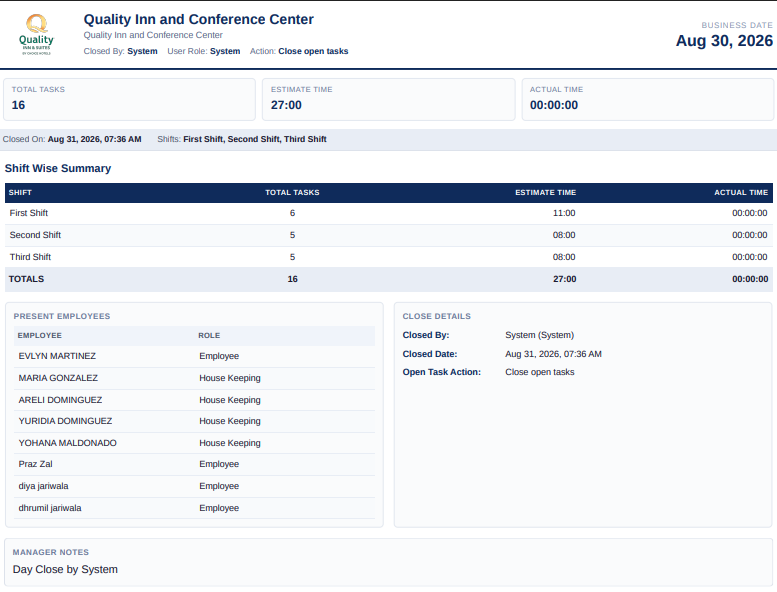
The summary provides information such as:
- Business date
- Total tasks
- Total estimated time
- Total actual time
- Close information
- Present employees
- Manager notes
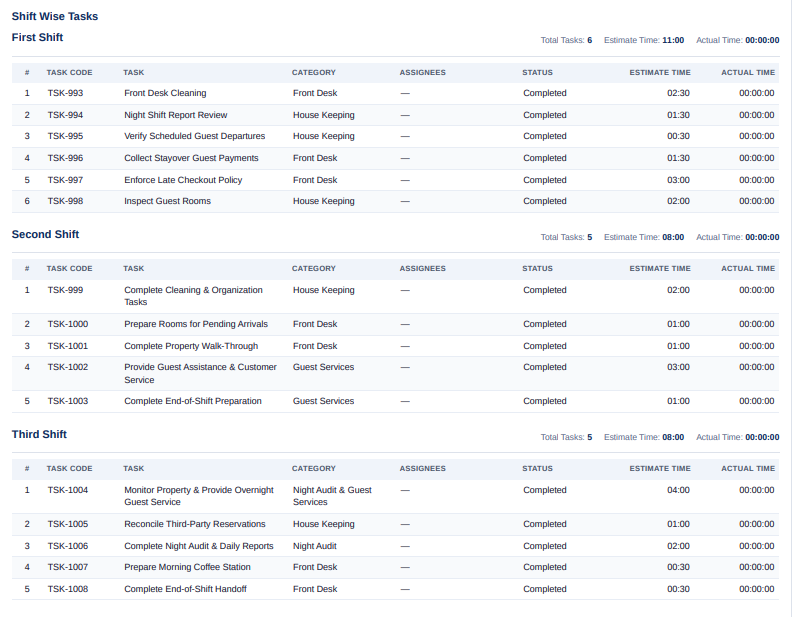
- Task details
- Task code
- Task category
- Assignee
- Task status
- Estimated time
- Actual time
Task Summary Details
The daily task summary contains the following sections.
Summary Information
The top section provides an overall summary for the selected business date.
| Field | Description |
|---|---|
| Business Date | The business date associated with the task summary. |
| Total Tasks | Total number of tasks for the entire day across all shifts. |
| Estimate Time | Combined estimated duration of all tasks. |
| Actual Time | Combined actual time recorded for the tasks. |
| Closed By | User or system that closed the task day. |
| Closed Date | Date and time when the day was closed. |
| Open Task Action | Indicates how Open/Active tasks were handled when the day was closed. |
Present Employees
The summary includes employees who were present and available during the task day.
The employee section can include:
| Field | Description |
|---|---|
| Employee | Name of the employee who was present. |
| Role | Employee's assigned role. |
This information helps managers understand which employees were available during the business day.
Close Details
The Close Details section records how and when the task day was closed.
| Field | Description |
|---|---|
| Closed By | Name of the user or system that closed the day. |
| Closed Date | Date and time when the day was closed. |
| Open Task Action | Action automatically applied to Open or Active tasks during closing. |
Manual Close
If a manager closes the day manually, the summary records the manager's user information.
Example:
Closed By: John Smith
Closed By Role: Manager
Closed Date: Aug 31, 2026, 07:36 AM