Maintenance
Overview
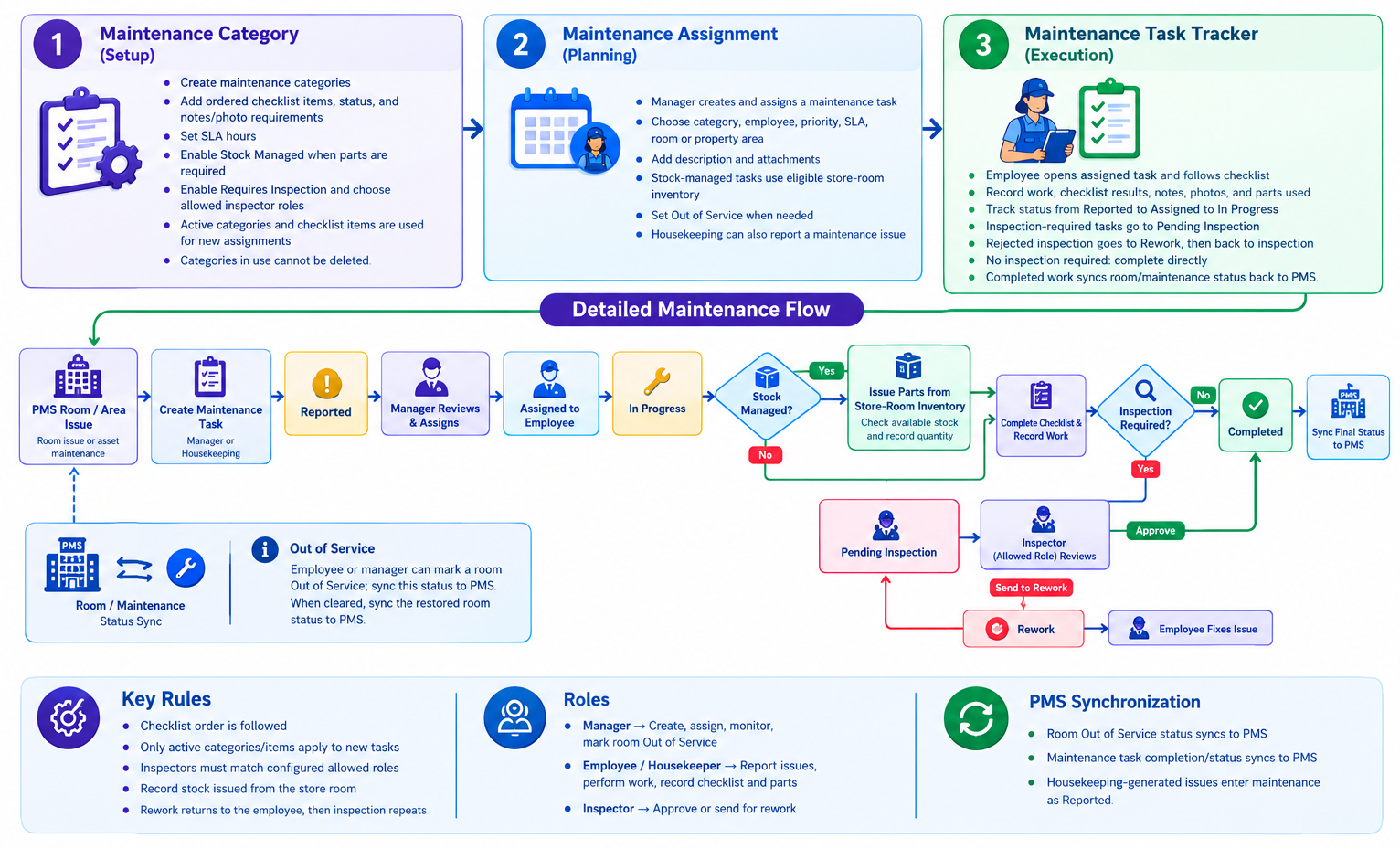
The SpendWell iHospitality Maintenance module manages the complete maintenance lifecycle, from identifying a maintenance issue in a room or property area through task creation, assignment, execution, inspection, rework, and completion.
The module supports two maintenance task creation workflows: Maintenance Assignment by Manager and Maintenance Task Creation from the Housekeeping module by Housekeeper. Both workflows use the same maintenance categories, checklist configuration, task tracking, inventory management, and completion process.
SpendWell iHospitality also synchronizes room Out of Service status and maintenance task status with the property's PMS, helping maintain consistent room and maintenance information across both systems.
Maintenance Workflow
The Maintenance module consists of three main areas:
- Maintenance Category – Defines maintenance types, checklists, SLA, stock requirements, and inspection rules.
- Maintenance Assignment – Allows managers to create and assign maintenance tasks and allows housekeepers to report maintenance issues through the Housekeeping module.
- Maintenance Task Tracker – Manages task execution, checklist completion, inventory usage, inspection, rework, and final completion.
Maintenance Flowchart
1. Maintenance Category
Purpose: Define the type of maintenance work and the requirements for completing it.
Maintenance Categories establish the standards and requirements employees must follow for different maintenance activities.
Key Features
- Create maintenance categories such as Electrical Maintenance, Plumbing Maintenance, and HVAC Maintenance.
- Add checklist items and configure their display order.
- Set checklist items as Active or Inactive.
- Configure whether checklist items require notes or photos.
- Define the maintenance SLA in hours.
- Enable Stock Managed when maintenance work requires parts or materials from store-room inventory.
- Enable Requires Inspection when maintenance work must be inspected before completion.
- Configure the user roles authorized to inspect maintenance tasks.
- Active categories and checklist items are used for new assignments.
- Inactive categories and checklist items are excluded from new assignments.
- Categories already in use cannot be deleted.
Stage: Setup
2. Maintenance Assignment
Purpose: Create maintenance tasks, identify the affected location, and assign work to employees.
Maintenance tasks can enter the system through two separate workflows.
A. Maintenance Assignment by Manager
The manager creates and assigns maintenance tasks directly from the Maintenance module.
Key Features
- Generate a maintenance code for the task.
- Select the maintenance category and assigned employee.
- Set the task priority and SLA.
- Select the location type: Room or Area.
- For room-based tasks, select the applicable floor and room.
- For area-based tasks, select the applicable property area.
- Add a task description and upload supporting attachments.
- Mark the room Out of Service when required.
- Automatically apply the configured maintenance checklist.
- Check store-room inventory when Stock Managed is enabled.
- Create the task and make it available in the Maintenance Task Tracker.
Workflow: Create Assignment → Configure Task Details → Check Stock Requirements → Assign Employee → Task Available in Task Tracker
B. Maintenance Task Creation by Housekeeper
The housekeeper reports a maintenance issue directly from the Housekeeping module when a defect or maintenance requirement is identified during room cleaning or other housekeeping activities.
Key Features
- Create a maintenance task without leaving the Housekeeping module.
- Identify the affected room or property area.
- Select the applicable maintenance category.
- Enter the issue description and add supporting photos or attachments.
- Save the reported issue with the Reported status.
- Make the task available to the manager for review.
- Allow the manager to validate the issue, set priority and SLA, and assign an employee.
- Continue the task through the same Maintenance Task Tracker used for manager-created tasks.
Workflow: Identify Issue → Create Maintenance Task → Enter Details → Save as Reported → Manager Review → Assign Employee
3. Maintenance Task Tracker
Purpose: Execute maintenance work and manage checklist completion, inventory usage, inspection, rework, and closure.
The Maintenance Task Tracker provides a centralized workspace where employees and managers can monitor maintenance tasks throughout their lifecycle.
Maintenance Task Statuses
- Reported: A new maintenance issue has been created and is awaiting review or assignment.
- Assigned: The maintenance task has been assigned to an employee.
- In Progress: The assigned employee has started the maintenance work.
- Pending Inspection: The employee has completed the required work and submitted the task for inspection.
- Rework: The inspector has identified work that requires correction.
- Completed: The maintenance work has been completed and all required inspection steps have been passed.
Employee Responsibilities
The assigned employee can:
- Open the assigned maintenance task.
- Start the task and move it to In Progress.
- Review and complete the configured maintenance checklist in the required order.
- Add notes and photos when required.
- Record parts and materials used for maintenance.
- Complete the work and submit it for inspection when inspection is required.
- Complete the task directly when inspection is not required.
- Fix rejected items when the task is returned for Rework.
- Resubmit the corrected task for inspection.
Manager Responsibilities
The manager can:
- Review maintenance issues reported by housekeepers.
- Create and assign maintenance tasks directly.
- Set task priority, SLA, category, location, and employee.
- Monitor task progress and overdue work.
- Mark a room Out of Service when necessary.
- Monitor inventory usage for stock-managed maintenance.
- Review task progress and manage room status according to permissions.
Inspector Responsibilities
When inspection is required, an authorized inspector can:
- Open tasks in Pending Inspection.
- Review the completed maintenance checklist and supporting notes or photos.
- Approve the completed work.
- Send the task to Rework if corrective work is required.
- Review the task again after the employee completes the rework.
- Approve the task when the required work meets the property's maintenance standards.
If inspection is not required, the task proceeds directly to Completed after the required work and checklist are completed.
Stage: Execution, Inspection, and Completion
4. Inventory and Stock Management
Purpose: Track maintenance parts and materials issued from the property's store-room inventory.
When a maintenance category is configured as Stock Managed, the maintenance workflow checks the available inventory before parts are issued for the task.
Key Features
- Check available quantities in the applicable store-room inventory.
- Select the parts or materials required for the maintenance task.
- Record the quantity issued against the maintenance task.
- Update inventory balances according to the actual quantity issued.
- Maintain a record of parts used for each maintenance task.
- Support inventory tracking for stock-managed maintenance work.
When Stock Managed is disabled, the task follows the normal maintenance workflow without the required store-room stock-issue process.
5. Room Out of Service Management
Purpose: Prevent a room from being treated as available when maintenance makes it unsuitable for guest occupancy.
Key Features
- Mark the affected room Out of Service during maintenance task creation or execution.
- Synchronize the Out of Service room status with the PMS.
- Keep the room unavailable according to the property's configured PMS room-status rules.
- Clear the Out of Service condition after the issue is resolved and the room is authorized to return to service.
- Synchronize the restored room status back to the PMS.
Important: Completing a maintenance task does not automatically clear the room's Out of Service condition. Room availability should be restored only after the required authorization and room-status checks.
Key Rules
- Maintenance tasks can be created by a manager or reported by a housekeeper.
- Both entry points use the same maintenance task lifecycle.
- Housekeeping-generated issues start with the Reported status and are reviewed before assignment.
- Only active maintenance categories and checklist items apply to new assignments.
- Checklist items must be completed in the configured order.
- Only authorized user roles can inspect tasks.
- Stock-managed maintenance must follow the configured store-room inventory issue process.
- Tasks requiring inspection cannot be completed until the required inspection is approved.
- Rejected tasks return to the employee for Rework and must be submitted for inspection again.
- Tasks not requiring inspection can proceed directly to Completed after all required work is finished.
- Room Out of Service status and relevant maintenance task updates are synchronized with the PMS according to the configured integration.
- A room's Out of Service status must be cleared separately when appropriate.
Roles and Responsibilities
- Manager: Creates assignments, reviews reported issues, assigns employees, monitors maintenance progress, manages Out of Service status, and oversees inventory usage.
- Housekeeper: Reports maintenance issues from the Housekeeping module and submits them for manager review.
- Maintenance Employee: Performs assigned maintenance work, completes checklists, records notes and photos, tracks parts used, and resolves rework.
- Inspector: Reviews maintenance work, approves successful tasks, or returns tasks for rework according to authorized roles.
PMS Synchronization
SpendWell iHospitality synchronizes relevant maintenance and room-status information with the property's PMS.
- Maintenance issue reporting: Housekeeping-generated maintenance issues enter the Maintenance module with the Reported status.
- Room Out of Service: Room availability changes are synchronized with the PMS.
- Maintenance task status: Relevant task status updates are synchronized according to the configured PMS integration.
- Room restoration: When an authorized user clears the Out of Service condition, the restored room status is synchronized with the PMS.
This workflow helps maintain consistent maintenance records and room availability information across SpendWell iHospitality and the PMS.
Maintenance Category
A category is the template for a type of work, such as Plumbing, HVAC, Locks, or Electrical. Every new work order copies its checklist, time target, inspection rule, and parts setting from the category chosen at creation.
What you set up
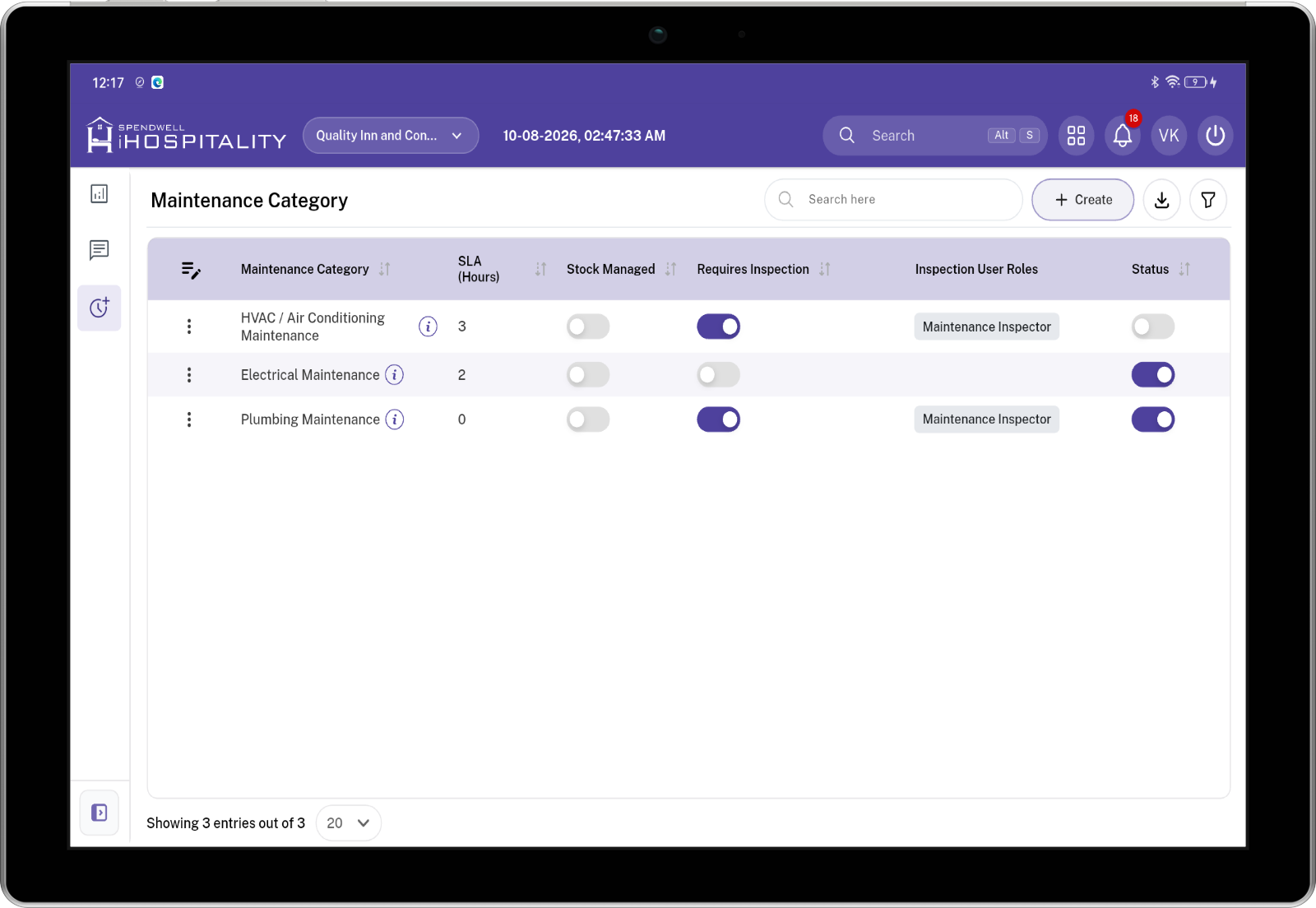
| Setting | What it does |
|---|---|
| Maintenance Category | The name people pick when they create a work order. Each property can have only one category with that name. Plumbing and plumbing count as the same name. |
| SLA (Hours) | How many hours the hotel allows from the moment the problem is reported. Zero means this kind of work has no time target. |
| Stock Managed | Turn on when technicians are expected to record parts for this kind of work. |
| Requires Inspection | Turn on when a second person must check the work before the work order can be completed. |
| Inspection User Roles | The job roles allowed to inspect. This list appears only when Requires Inspection is on. At least one role is required then. |
| Status | Active categories appear when someone creates a work order. Inactive categories stay on old work orders and drop out of the choice list. |
Company and property come from the property you are logged into.
Inspection User Roles
Turn on Requires Inspection, then choose the roles that may inspect, such as Maintenance Inspector.
Until someone starts the inspection, any active person at the property who has one of those roles can open the work order and start it. The first person who starts is the inspector for that work order from then on.
Leave inspection off when the technician is trusted to close the work order themselves.
Checklist
The checklist tab is required. Each row is one step, done from top to bottom.
| Column | What to enter |
|---|---|
| Display Order | The step number. The board follows this order. |
| Checklist Item | The step name, up to 100 characters. The same name cannot be used twice at the same display order. |
| Status | Active steps are copied onto new work orders. Inactive steps are kept on the category and left off new work orders. |
| Require Notes & Photos | Turn on when that step needs a written note or a photo before it can be marked done. |
Example for Plumbing:
| Order | Step | Notes and photos | Active |
|---|---|---|---|
| 1 | Shut off the water supply | No | Yes |
| 2 | Replace the supply line | Yes | Yes |
| 3 | Test for leaks | No | Yes |
On a new work order, every copied step starts as not done. Only active steps are copied.
How to add a category
- Open Maintenance Category and add a record.
- Enter the name.
- Set SLA (Hours). Use zero when this work has no deadline.
- Turn on Requires Inspection only when someone else must check the work; then choose the inspection roles.
- Turn on Stock Managed when parts should be recorded for this work.
- Add the checklist steps in the order the work is done.
- Save.
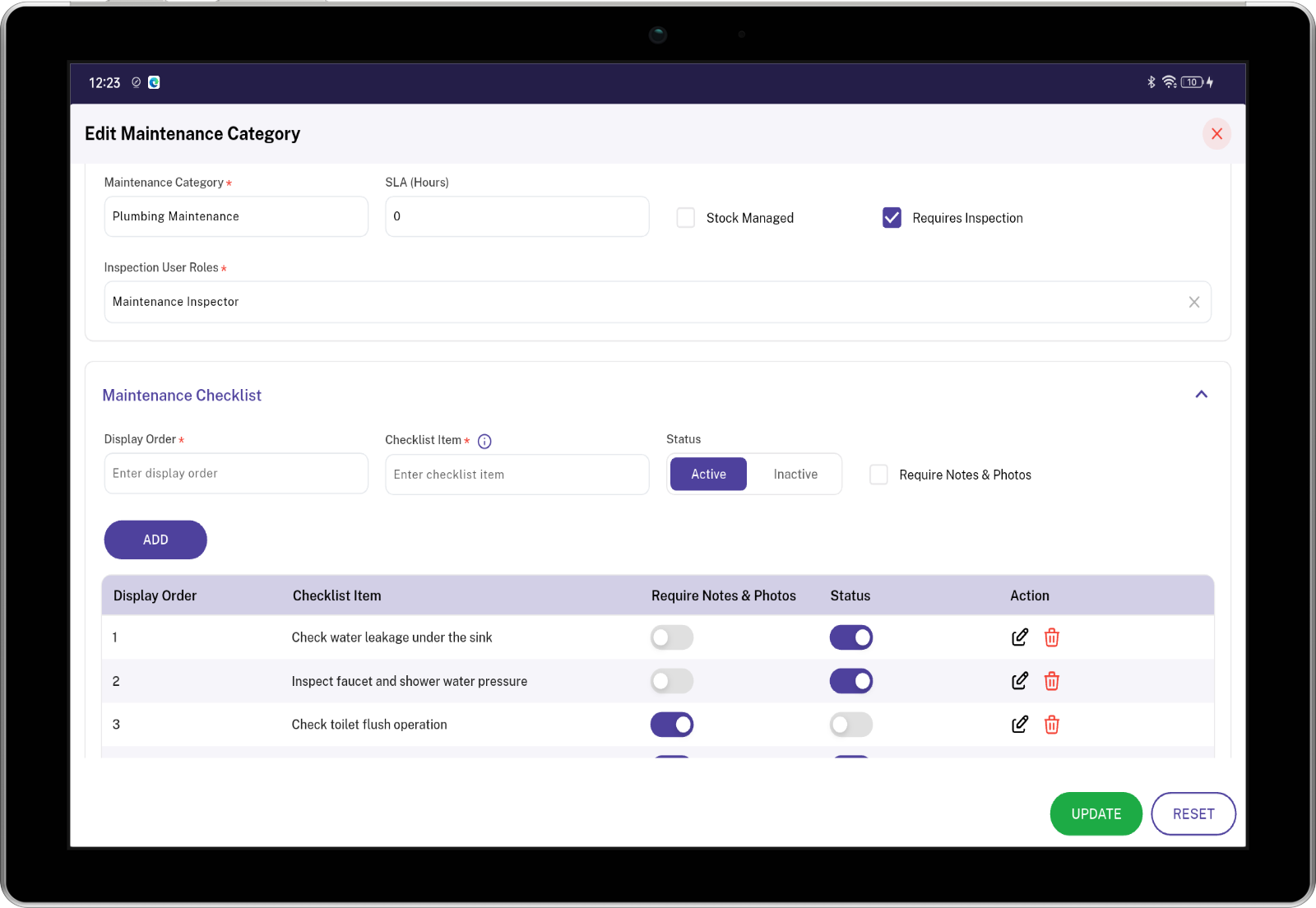
Saving a name that already exists at this property is rejected.
What is copied onto a work order
Creating a work order takes a snapshot of the category at that moment:
- the category name
- whether inspection is required
- the SLA hours
- whether stock is managed
- the inspection roles
- every active checklist step
The due time on the work order is the reported time plus the SLA hours. Zero hours means there is no due time.
Changing or removing a category later
| What you change | What happens to work orders |
|---|---|
| The category name | The name updates on work orders that already use this category. |
| SLA, inspection, roles, stock, or the checklist | Work orders already created keep the snapshot they received. They do not pick up the new setup. |
| The category on a work order that is still Reported or Assigned | That work order takes a fresh snapshot from the category you pick, including a new checklist. |
| The category on a work order after work has started | The change is rejected. |
| Delete | Allowed only when no work order uses the category. A built-in system category hides Delete. |
An inactive category remains on old work orders and no longer appears when someone creates a new one.
How this affects the floor
Write the steps in the order the job is actually done. On the board, the technician or inspector can mark only the next open step.
- Turn on Require Notes & Photos for any step that needs proof. That step cannot be completed with an empty note and no photo.
- Turn on Requires Inspection when the room or area should be checked before the work order closes. Choose roles that real inspectors have. With inspection on and no matching role, nobody on the floor can start the inspection.
- SLA (Hours) is the time promise. The board marks the work order late when the finish time, or the current time if it is still open, is past the due time.
Maintenance Assignment
This is where a work order is created, updated, or removed before the technician is deep into the job. The same work order then appears on the Maintenance Task board for the technician and the inspector.
Open this from Maintenance Assignment. Housekeeping can also raise one with Report Issue on a housekeeping task. That opens the same kind of work order, with the room already filled in and the source marked as Housekeeping.
The checklist, time target, and inspection rule come from the category. See Maintenance Category. Day-to-day start, pause, checklist, and inspection are in Maintenance Task.
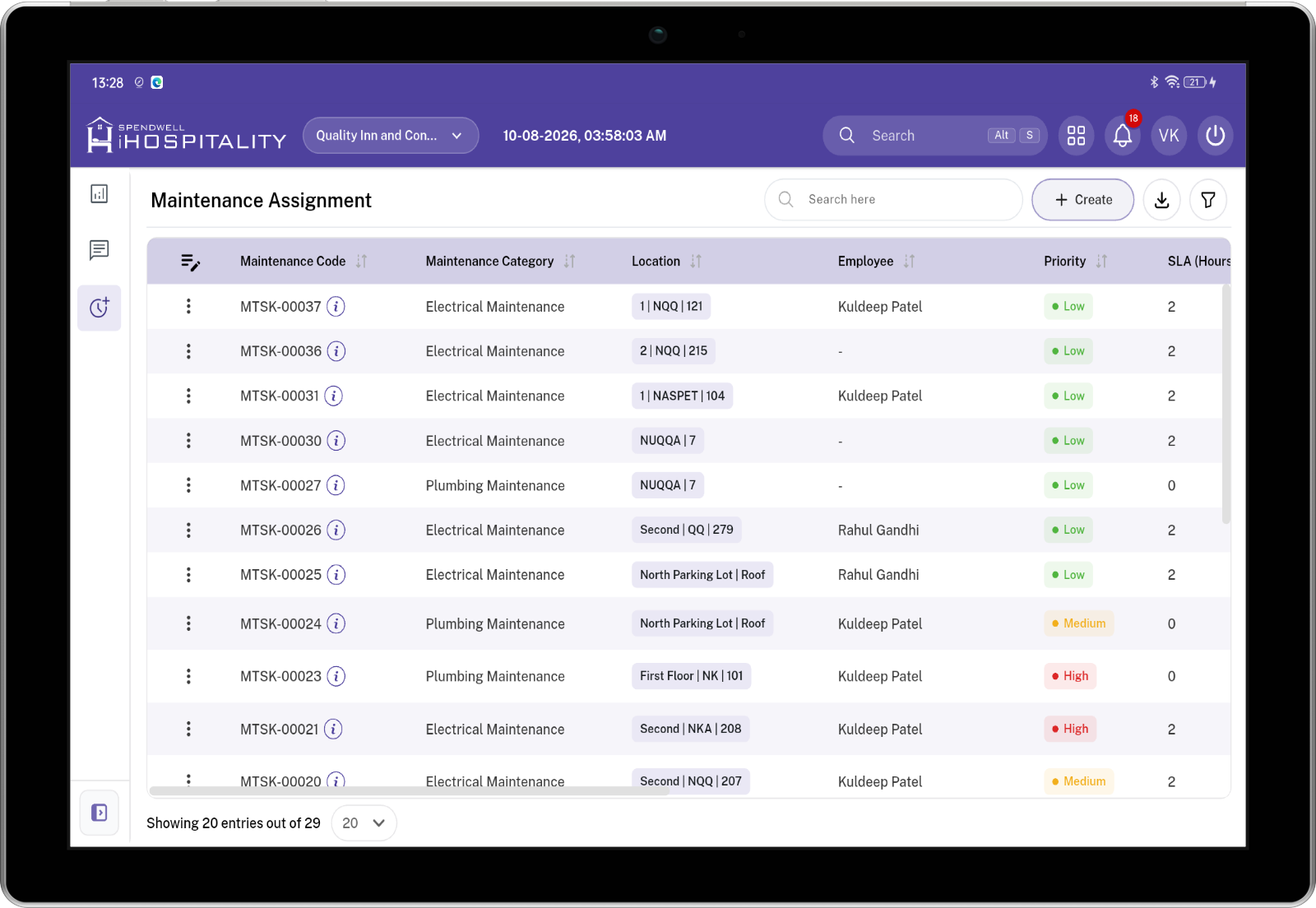
What you fill in
| Field | Required | What to enter |
|---|---|---|
| Maintenance Code | Yes | Filled from the property’s Maintenance Task series. It cannot be typed or changed later. Only active employees whose department is Maintenance are shown. |
| Employee | No | Leave empty to keep the work order in Reported, waiting for someone to assign it. Choose a technician to create it as Assigned. |
| Maintenance Category | Yes | The type of work. This copies the checklist, SLA hours, inspection rule, inspection roles, and stock setting onto the work order. |
| Priority | Yes | Low, Medium, High, or Critical. Starts as Low. |
| SLA (Hours) | Shown as required | On creation, the hours saved are the hours on the category. You can change the hours later by editing the work order. |
| Location Type | Yes | Room or Area. |
| Floor | No | Shown for a room. Filters the room list. |
| Room | Yes for a room | The guest room. The floor and room type are stored with it. |
| Area | Yes for an area | A public place such as the lobby or pool. The area type is stored with it. |
| Out of Service | No | Mark the room unavailable. On the task board, this can also be turned on or off later, for a room only. |
| Description | No | What is wrong. |
| Attachments | No | Photos of the problem. |
The person who saves the form is recorded as the one who reported it. The person who assigns a technician is recorded as the one who assigned it.
Choosing an employee sends that person a notification that the work order was assigned.
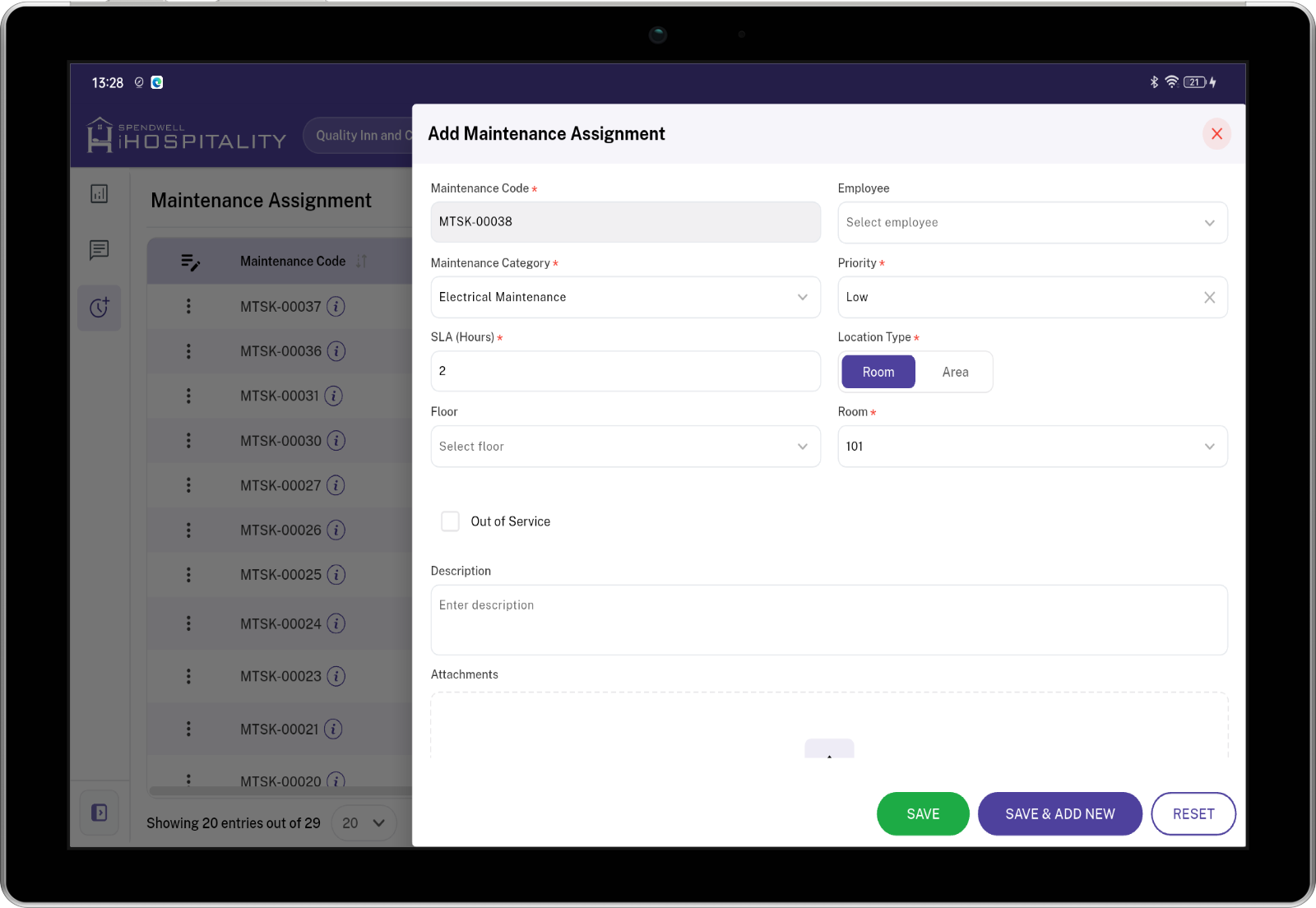
Employee -> Only active employees whose department is Maintenance are shown.
What happens when you save
| Employee chosen? | Where the work order starts |
|---|---|
| No | Reported. It is waiting to be assigned. |
| Yes | Assigned. The technician is named, and the assigned time is stored. Work has not started. |
The due time is the reported time plus the category’s SLA hours. Zero hours means there is no due time.
Active checklist steps from the category are copied onto the work order. Each step starts undone.
A history line is added: who reported it, or who it was assigned to.
Report Issue from housekeeping
On a housekeeping task, Report Issue creates a maintenance work order for that same guest room.
The room, floor, and room type come from the housekeeping task. The person still chooses the category, priority, description, photos, and, if they want, a technician.
The work order is marked as coming from Housekeeping. The message after saving says it was reported and names the technician when one was selected.
Who can see the list
The list is for the property you are logged into. It can be filtered by the date the work order was reported.
| Login | Work orders in the list |
|---|---|
| Admin | All of them. |
| Supervisor, with full edit rights on maintenance | Their own, their team’s, ones they reported, inspection work their role may see, and unassigned work. |
| Technician or inspector, with self-edit rights | Work assigned to them, work they reported, and inspection work they are allowed to see. |
The list shows the code, category, location, employee, priority, SLA hours, due time, out of service, description, photos, who assigned it, and the reported date. It can be exported to Excel.
Edit
A completed work order cannot be edited.
These can be changed while the work order is still open: description, photos, priority, location, out of service, and SLA hours. Changing the hours recalculates the due time from the original reported time.
The category and the technician can be changed only while the work order is Reported or Assigned, before anyone has started the timer.
Changing the category replaces the checklist, inspection rule, inspection roles, SLA hours, and stock setting with a fresh copy from the new category.
Changing the technician moves the work order to Assigned, records who assigned it, adds a history line, and notifies the new technician.
These stay under the control of the task board, and a normal edit does not overwrite them: the column, the timer, the checklist progress, the history, the notes, the inspector, and the maintenance code.
Delete
Delete is available only while the work order is Reported or Assigned. After the technician starts, the work order stays on record through rework and completion.
Assign from this form and from the board
You can name the technician here at creation or while editing, as long as work has not started.
On the Maintenance Task board, a supervisor can also assign, reassign, or clear the technician. Clearing the technician sends the work order back to Reported and notifies the removed person. That board behavior is described in Maintenance Task.
The employee list shows people in the Maintenance department for this property:
| Tag | Meaning |
|---|---|
| Present | Clocked in. |
| Schedule | Has a published shift today and is not clocked in. |
| Absent | Neither clocked in nor on today’s published schedule. |
A supervisor with full rights sees the maintenance team under their roles. A person with only self rights sees themselves.
Maintenance Task
This is the daily board. A technician starts the job, works through the checklist, and pauses before leaving. An inspector checks the work when the category requires it. A supervisor assigns the work order before it starts.
Open this from Maintenance Task. You can use a list or a board with one column per stage.
Maintenance Task has two views. The icons at the top right switch between them. Desktop opens in Kanban View. A phone opens in Plain View. Search, the reported-date range, and the filters stay the same in both.
Switch the view
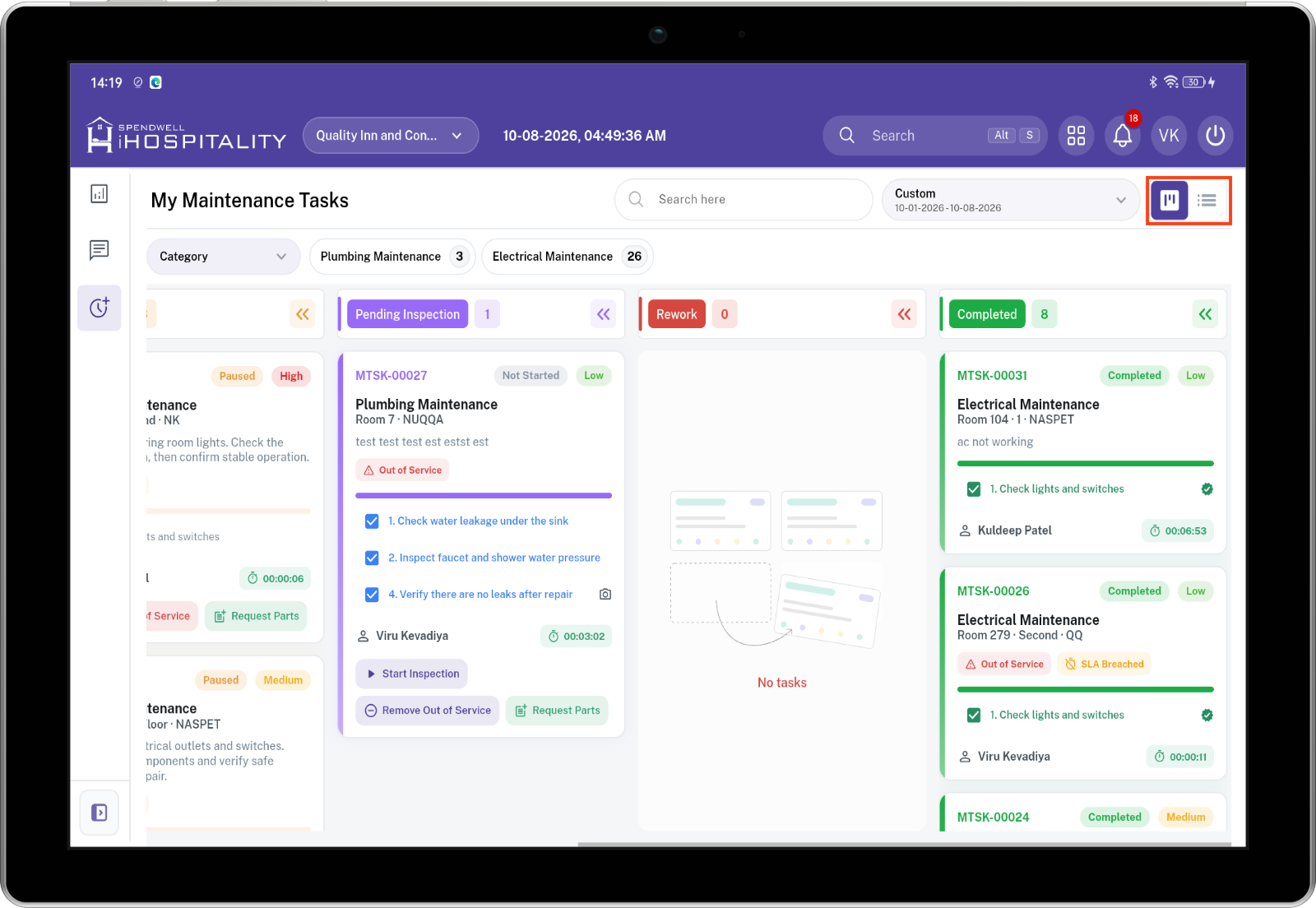
The board icon is Kanban View. The list icon is Plain View. Tap one to change the layout. The same work orders stay on screen. Only the way they are arranged changes.
Kanban View
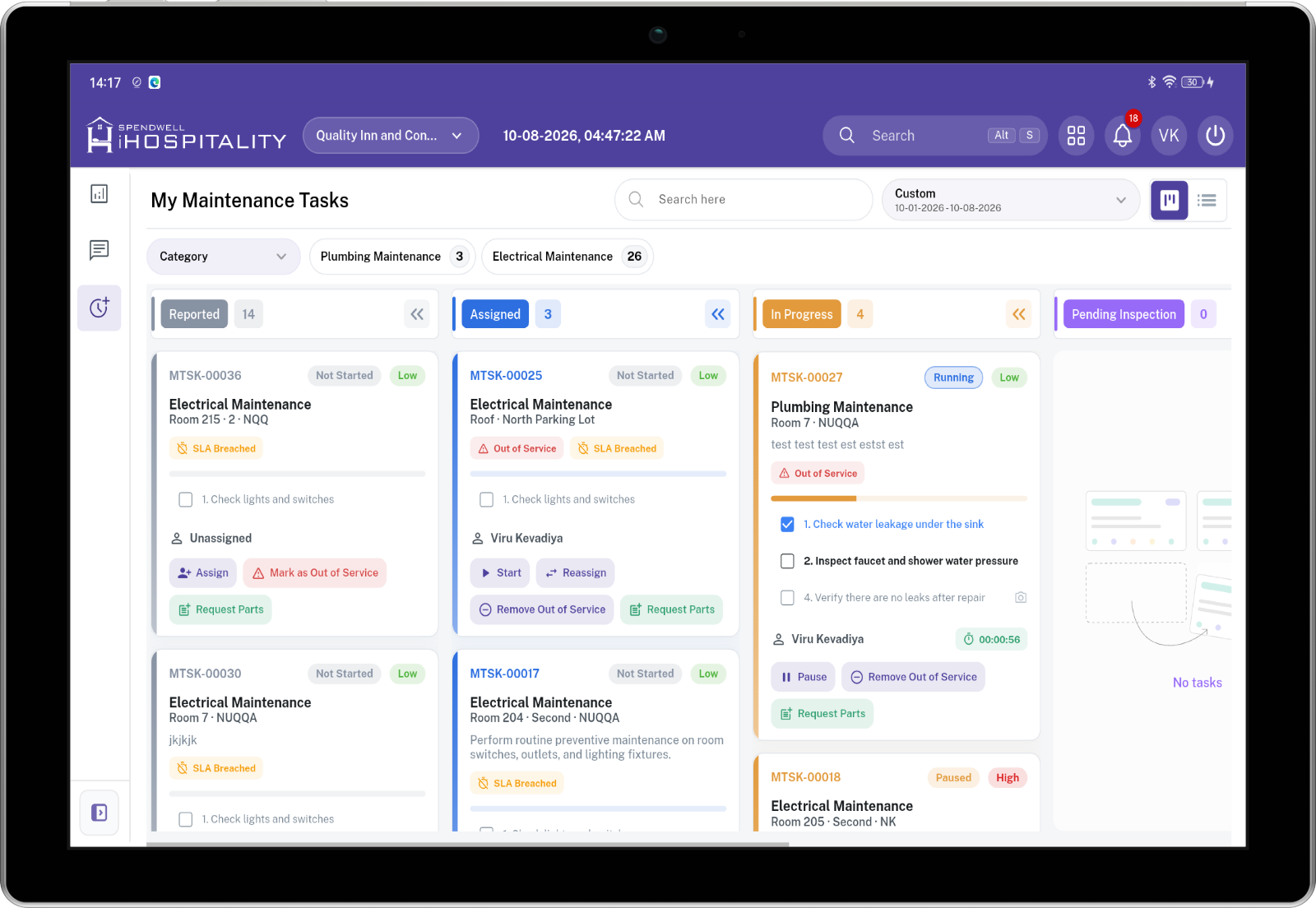
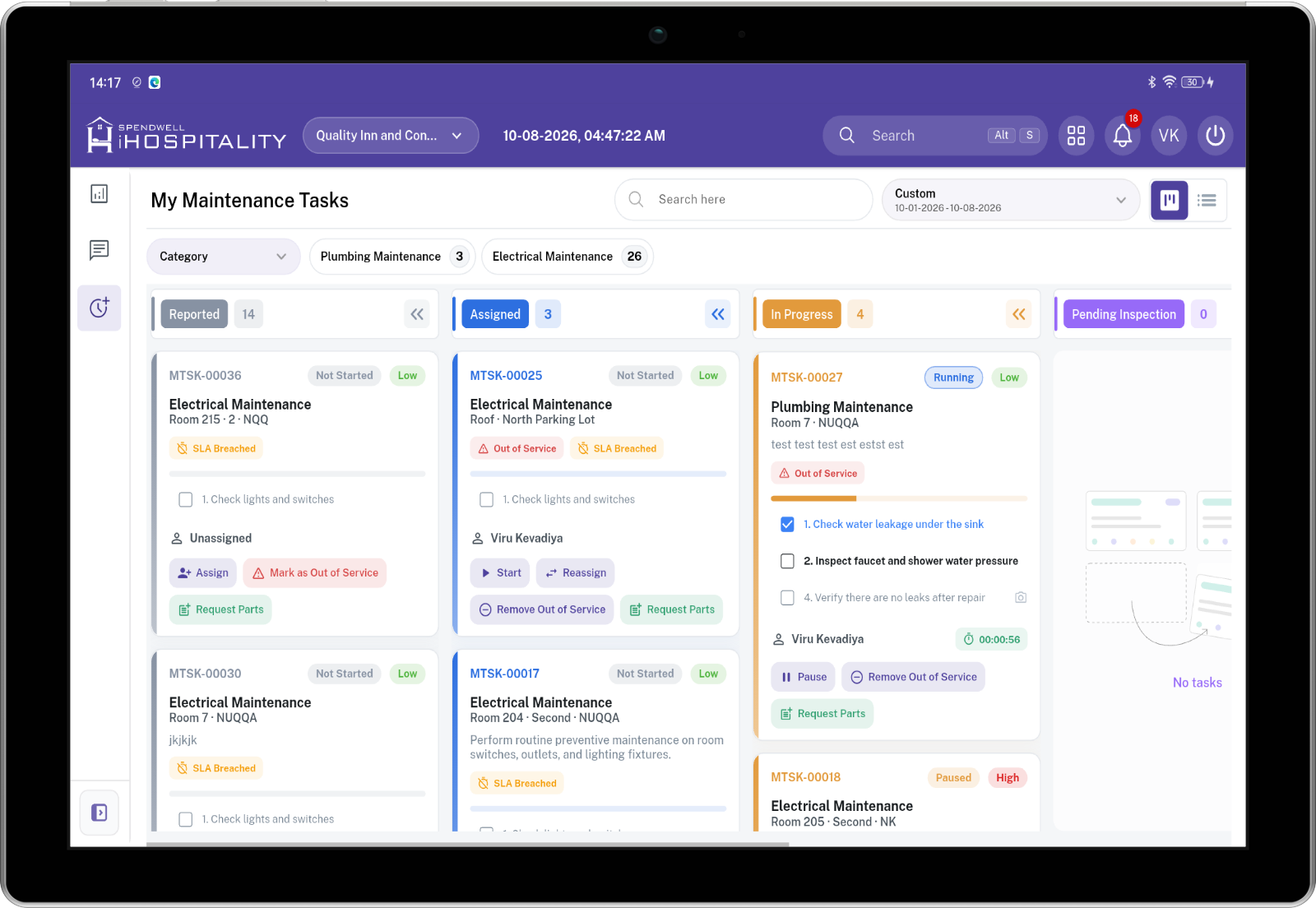
Kanban View is the column board. One column is one stage. Cards sit in the column that matches where the work is now. Each column has its own color, name, and count. Scroll inside a column to load more cards for that stage only.
Drag a card into the next allowed column to move it. Drag a Reported card onto Assigned to assign it to yourself. A card in Pending Inspection is not dragged to Rework or Completed. Those moves happen by marking checklist steps.
| Column | What it means |
|---|---|
| Reported | Created. No technician yet. |
| Assigned | A technician is named. Work has not started. |
| In Progress | The technician is working, or has paused. |
| Pending Inspection | The technician is done. Inspection has not started, or is underway. |
| Rework | The inspector sent one or more steps back. |
| Completed | Closed. It stays closed. |
Plain View
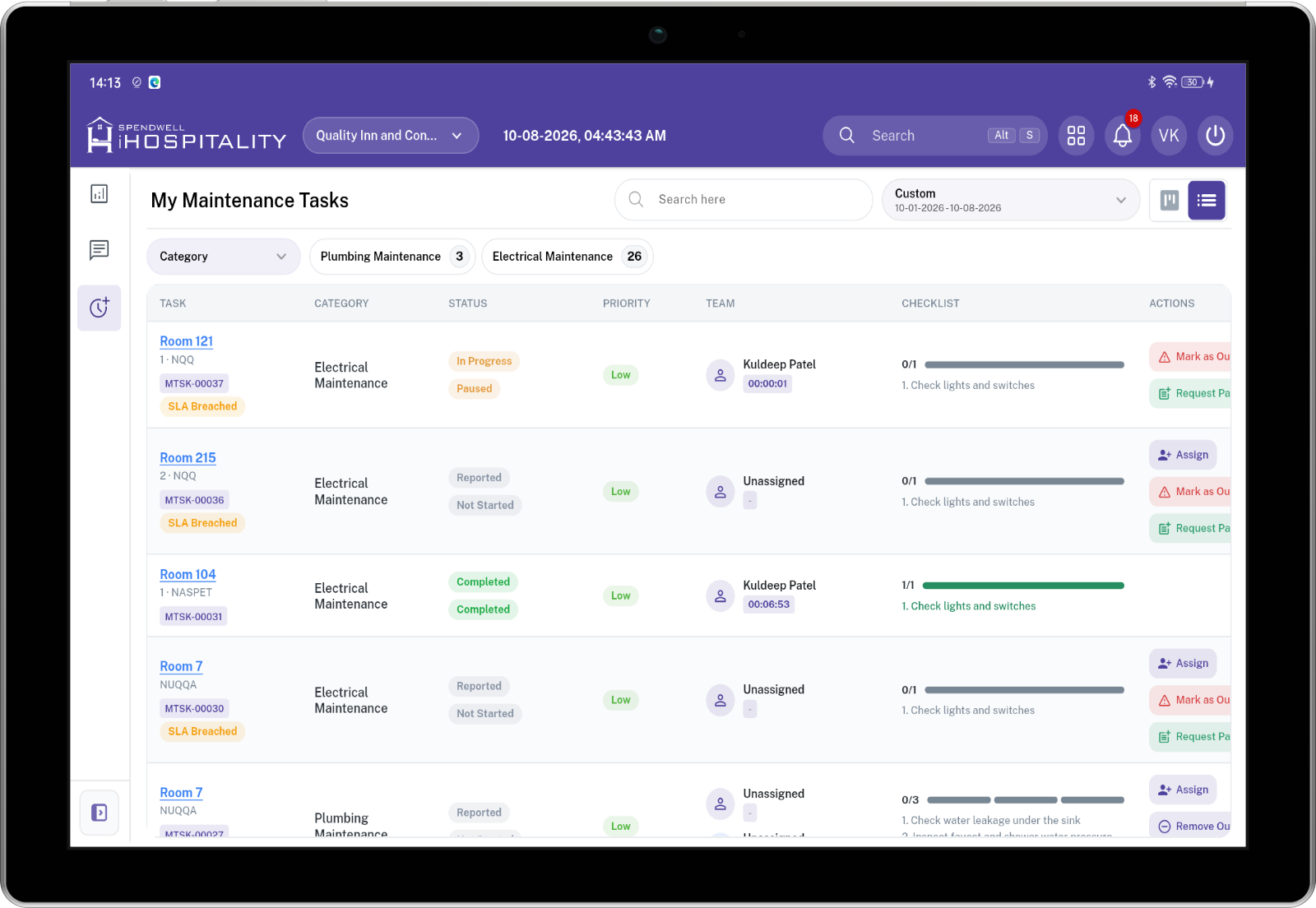
Plain View is one table. There are no columns to drag between. Newest reported work orders are first. Load more at the bottom brings the next page.
| Column | What it shows |
|---|---|
| Task | Work order code, room or area, and stage |
| Category | Maintenance category |
| Status | Timer status: Not Started, Running, Paused, or Completed |
| Priority | Low, Medium, High, or Critical |
| Team | Technician, and the inspector when one has started |
| Checklist | How many steps are done |
| Actions | The same buttons as on the Kanban card for that stage |
Filters
Switch between list and columns. The columns follow the order above. Each column loads more work orders as you scroll. The list is newest reported first.
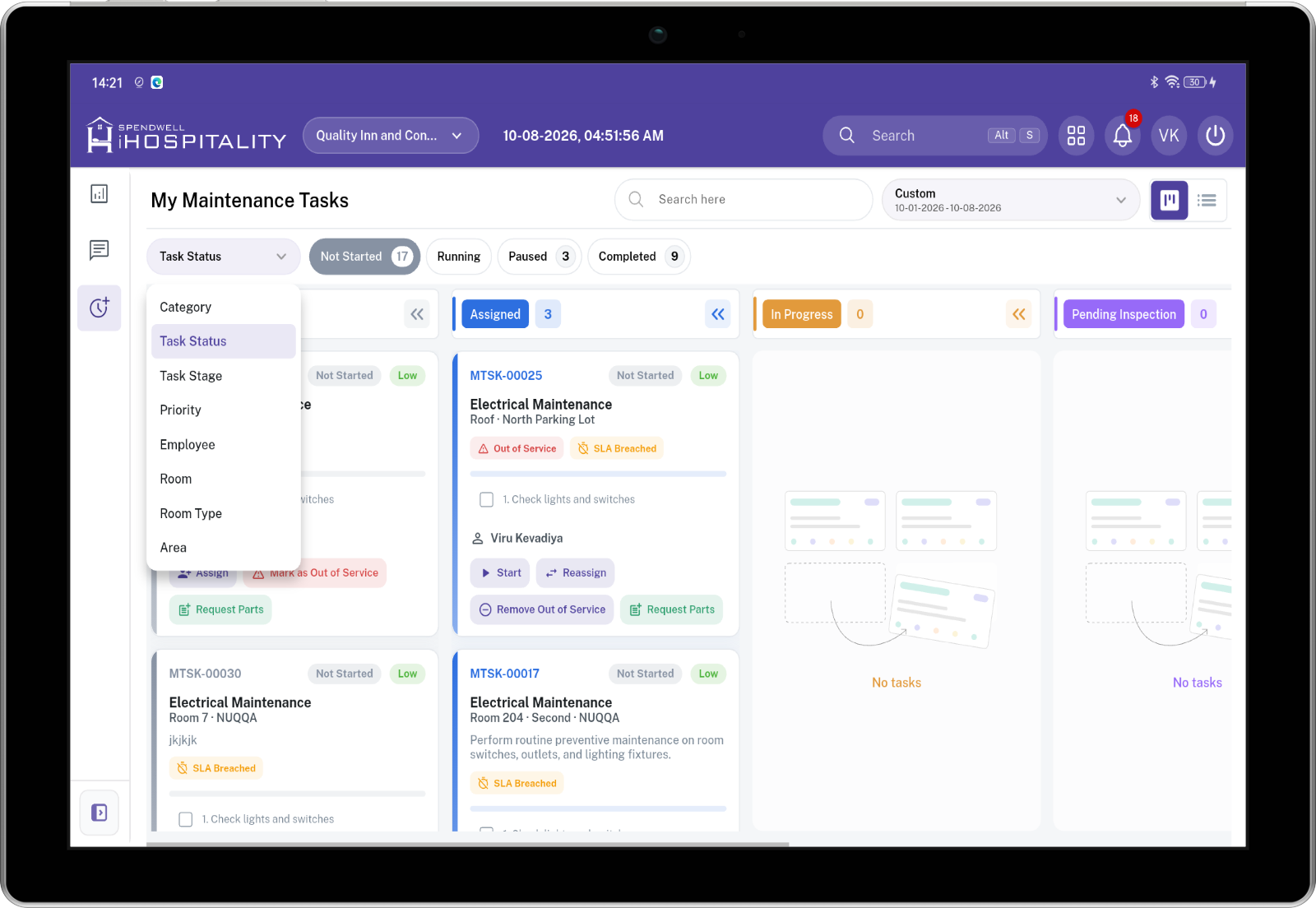
Filters, each with a count of matching work orders:
- Category
- Timer status
- Column
- Priority
- Employee
- Room
- Room type
- Area
Choosing a category narrows the other filters. The date range uses the reported date.
A card shows the code, category, room or area, priority, technician, time target, and checklist progress.
Stage and timer
The stage is the column. The timer status is whether work inside that column is stopped, running, or paused.
A work order can sit in In Progress while the timer is Paused. Pausing does not move it to another column.
| Order | Stage | Meaning |
|---|---|---|
| 1 | Reported | Created, and no technician is assigned. |
| 2 | Assigned | A technician is named. The timer has not started. |
| 3 | In Progress | The technician is working or has paused. |
| 4 | Pending Inspection | The technician is done. An inspector has not started, or is inspecting now. |
| 5 | Rework | The inspector sent one or more steps back. |
| 6 | Completed | Closed. It stays closed. |
Timer
| Timer status | Meaning |
|---|---|
| Not Started | The timer for this column has not been started. |
| Running | The timer is running. |
| Paused | The timer is paused. Time already counted is kept. |
| Completed | Used when the column is Completed. |
| Column | Timer you will see |
|---|---|
| Reported | Not Started |
| Assigned | Not Started |
| In Progress | Running or Paused |
| Pending Inspection | Not Started while waiting, then Running or Paused during the inspection |
| Rework | Not Started until the technician starts again |
| Completed | Completed |
Two clocks are kept separate:
- Work time counts while the technician’s timer is running in In Progress.
- Inspection time counts while the inspector’s timer is running in Pending Inspection.
A person can have one running work timer and one running inspection timer. Starting a second timer of the same kind prompts them to confirm. Confirming pauses the other job and starts this one.
How a work order moves
- A technician can be changed only in Reported and Assigned.
- In Progress goes to Completed when inspection is not required and every checklist step is done.
- In Progress goes to Pending Inspection when inspection is required and every checklist step is done.
- From Pending Inspection, Rework and Completed happen by marking checklist steps, one at a time. The card is not dragged there.
- Completed cannot be edited, deleted, or moved.
Who sees which work orders
| Login | What the board shows |
|---|---|
| Admin | Every work order at the property. |
| Supervisor, with full edit rights | Work assigned to them and to people in roles under them, work they reported, inspection work their role may see, and unassigned work. |
| Technician or inspector, with self-edit rights | Work assigned to them, work they reported, and inspection work they are allowed to see. |
Inspection work appears for you in Pending Inspection, Rework, and Completed when an inspection is required and either you have already started that inspection, or nobody has started it and your job role is one of the category’s inspection roles.
For the maintenance person
You are the technician named on the work order. Start, Pause, Resume, and Start Rework are shown to you.
| Column | What you do |
|---|---|
| Assigned | Tap Start. The card moves to In Progress and your work time starts. |
| In Progress, timer running | Tap Pause when you leave the job. |
| In Progress, timer paused | Tap Resume. |
| In Progress, and there is no checklist | Tap Send for Inspection when inspection is required. Tap Complete when it is not. |
| Rework | Tap Start Rework, then fix the steps the inspector sent back. |
If another job of yours is already running, confirm to pause that one and start this one.
Checklist
While your timer is running, mark steps from the top. You can mark only the next step that is still waiting or was sent back.
- When inspection is required, a step you finish becomes Completed. The inspector still has to accept it.
- When inspection is not required, a step you finish becomes Approved.
- When the step requires notes and photos, add a note or a photo. Saving with both empty is rejected.
When every step is Completed or Approved:
- Inspection required: the card moves to Pending Inspection.
- Inspection not required: the card moves to Completed.
On Rework, approved steps stay approved. Redo the steps that were sent back. When those are finished again, the card returns to Pending Inspection.
You can open a finished step to read its notes and photos.
Checklist colors
| Color | Meaning |
|---|---|
| Gray | Waiting, or not the step anyone can mark right now. |
| Black | The step it is your turn to mark. |
| Blue | The technician marked it done. It is waiting for inspection, or inspection was not required. |
| Green | Approved. |
| Red | Sent back for rework. While the technician is redoing that step, it is shown as the current step instead of red. |
Parts
Request Parts is available after the work order has left Reported and before it is Completed, for a person allowed to update that work order.
For each part:
- Choose an item, or Other / Not Found when the part is not in the system.
- For a stock item, choose a storeroom that still has quantity available.
- Enter the quantity and the unit.
- Choose Issue for parts used, or Return for parts put back.
- A part bought on the spot does not need a storeroom balance.
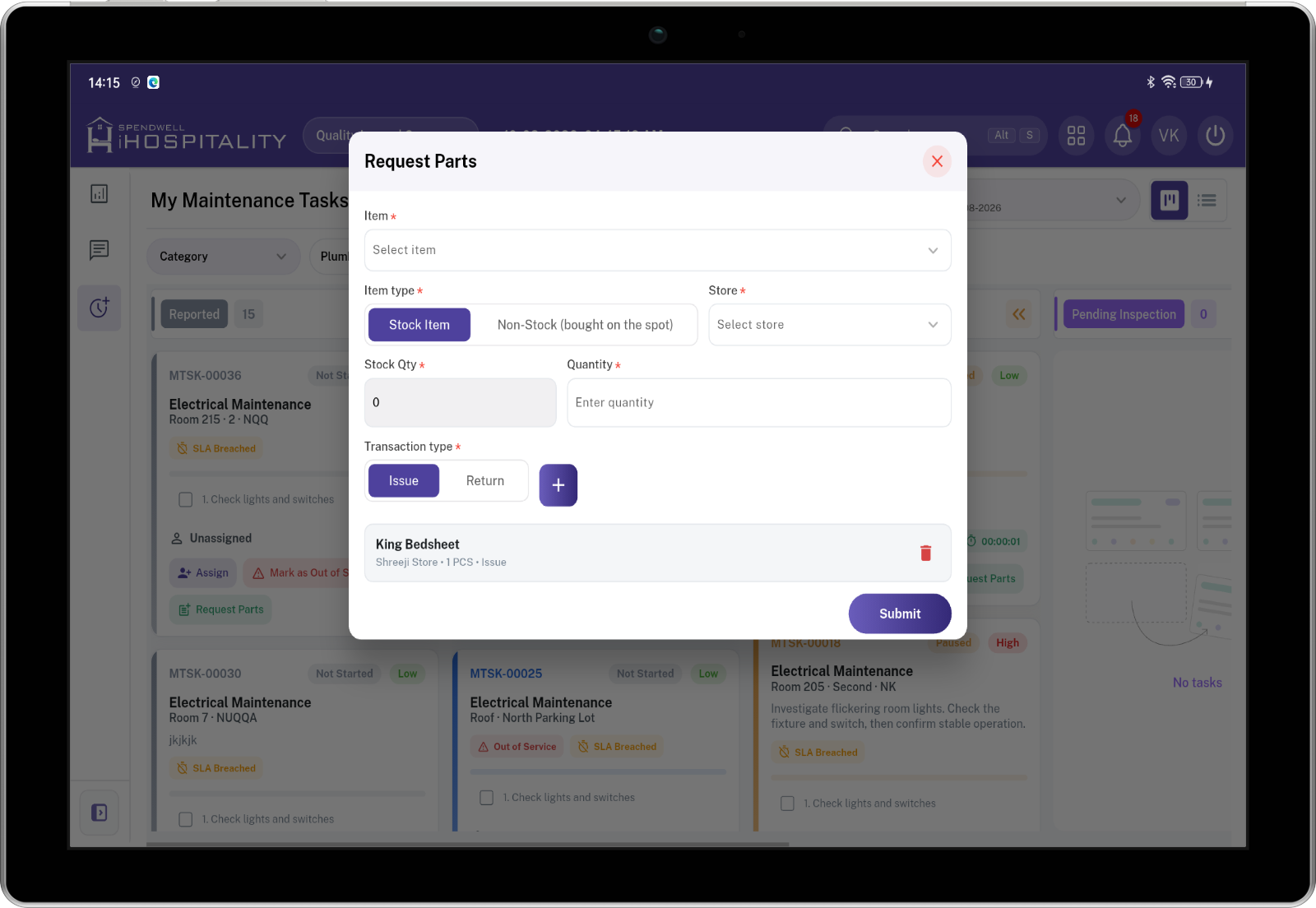
Each save is added to the work order history.
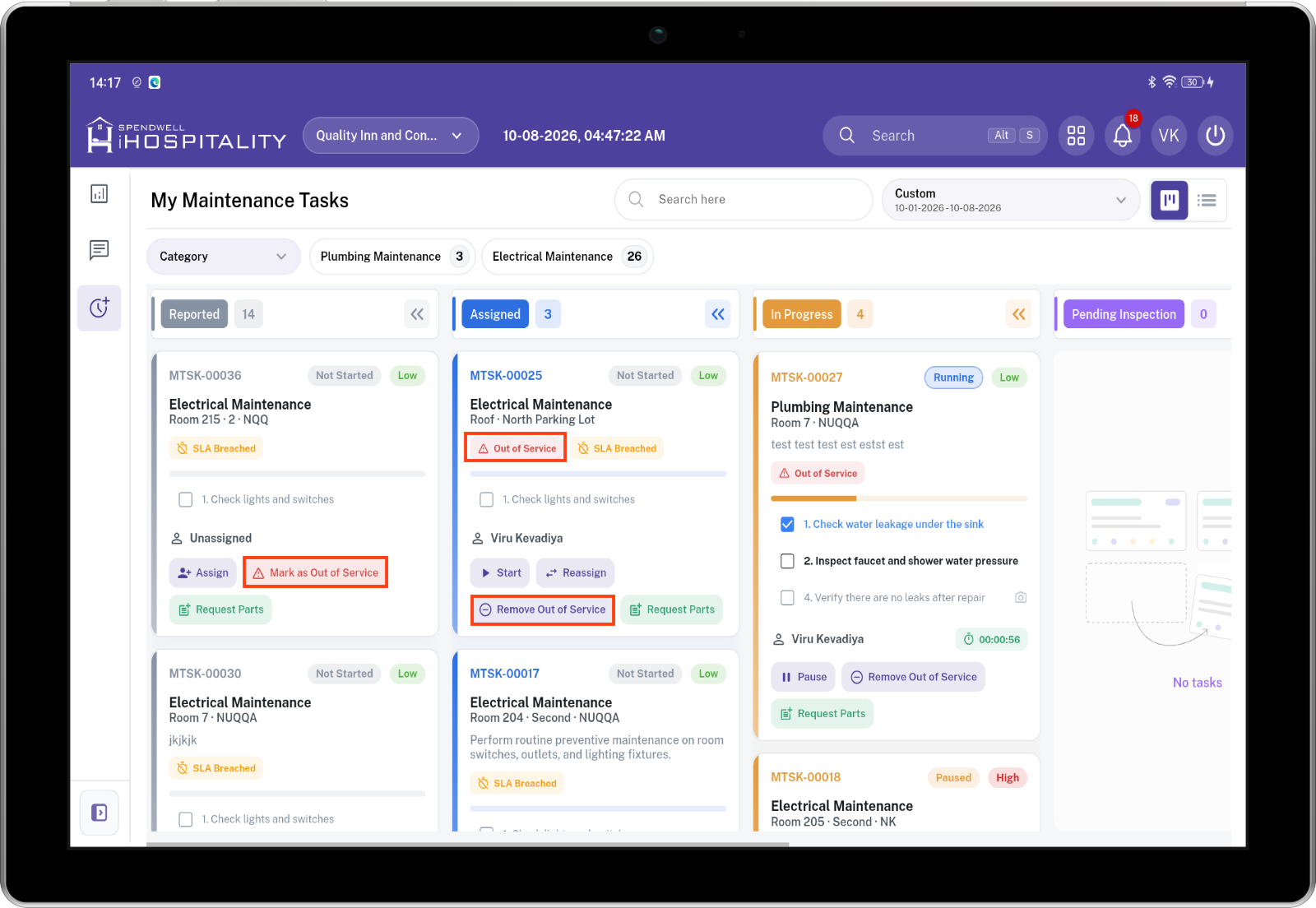
Room out of service
On a guest-room work order, Mark Out of Service takes the room out of order. Back in Service puts it back. This stays available until the work order is completed by a person allowed to assign that work order.
A public area has no room, so this action is rejected. Turning the same setting on or off a second time is rejected.
The room is updated in SpendWell. Sending that change on to the hotel system is switched off.
For the inspector
You work in Pending Inspection. You see a work order there when its category requires inspection, and your role is allowed to inspect it, or you are already the inspector on it.
Start the inspection
- Open the work order. The timer is Not Started.
- Tap Start Inspection. Your name is saved on the work order. The inspection stays with you.
- Use Pause and Resume the same way the technician does. If you already have another inspection running, confirming pauses that one.
The inspection has to be started before the work order can be approved or sent back. An admin can act as well. Another inspector does not take over after you have started.
Mark each step
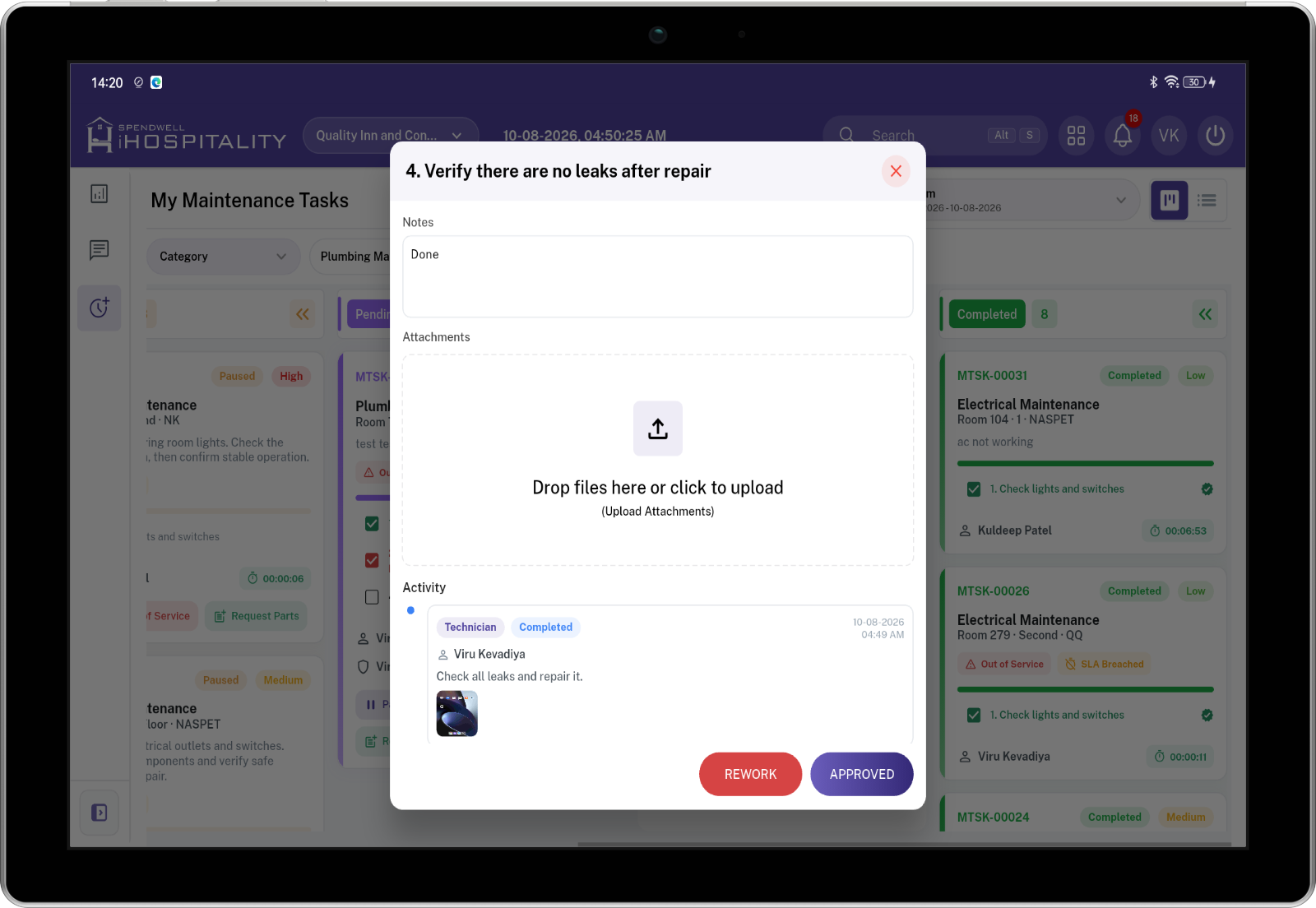
Go through the steps the technician marked Completedin order.
| Choice | When to use it |
|---|---|
| Approved | That step is acceptable. |
| Rework | The technician must do that step again. Add a note or a photo. |
The whole card is not dragged to Rework or Completed. When the last step is marked:
- Every step Approved: the work order moves to Completed. The technician and the person who reported it are told it was approved.
- Any step Rework: the work order moves to Rework. The technician is told. The work order is marked as rework.
When the technician finishes those steps, the work order comes back to Pending Inspection with you still as the inspector. Approved steps stay approved. Check the steps they redid.
A category that does not require inspection never enters this column. The technician closes it.
For the person who assigns work
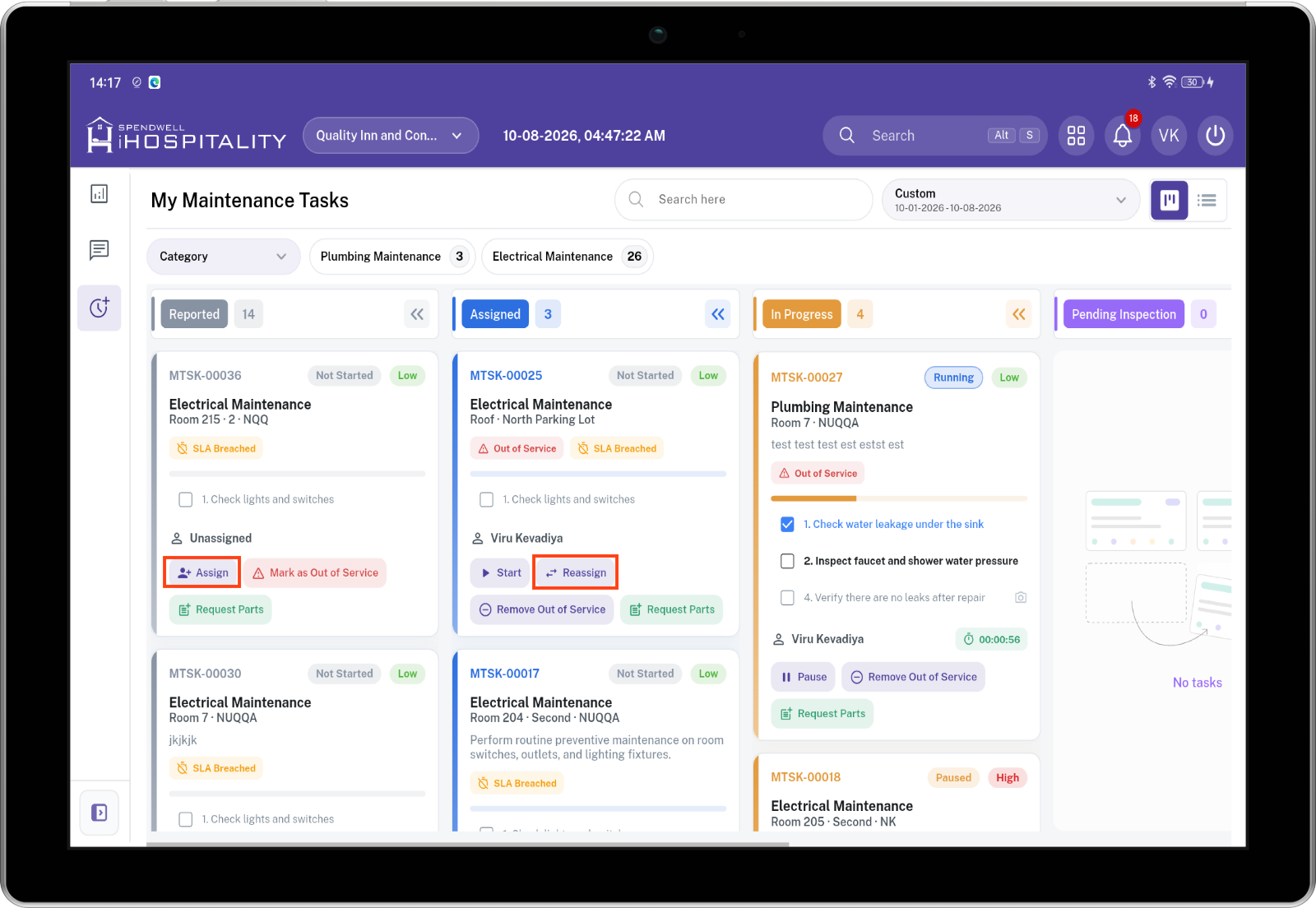
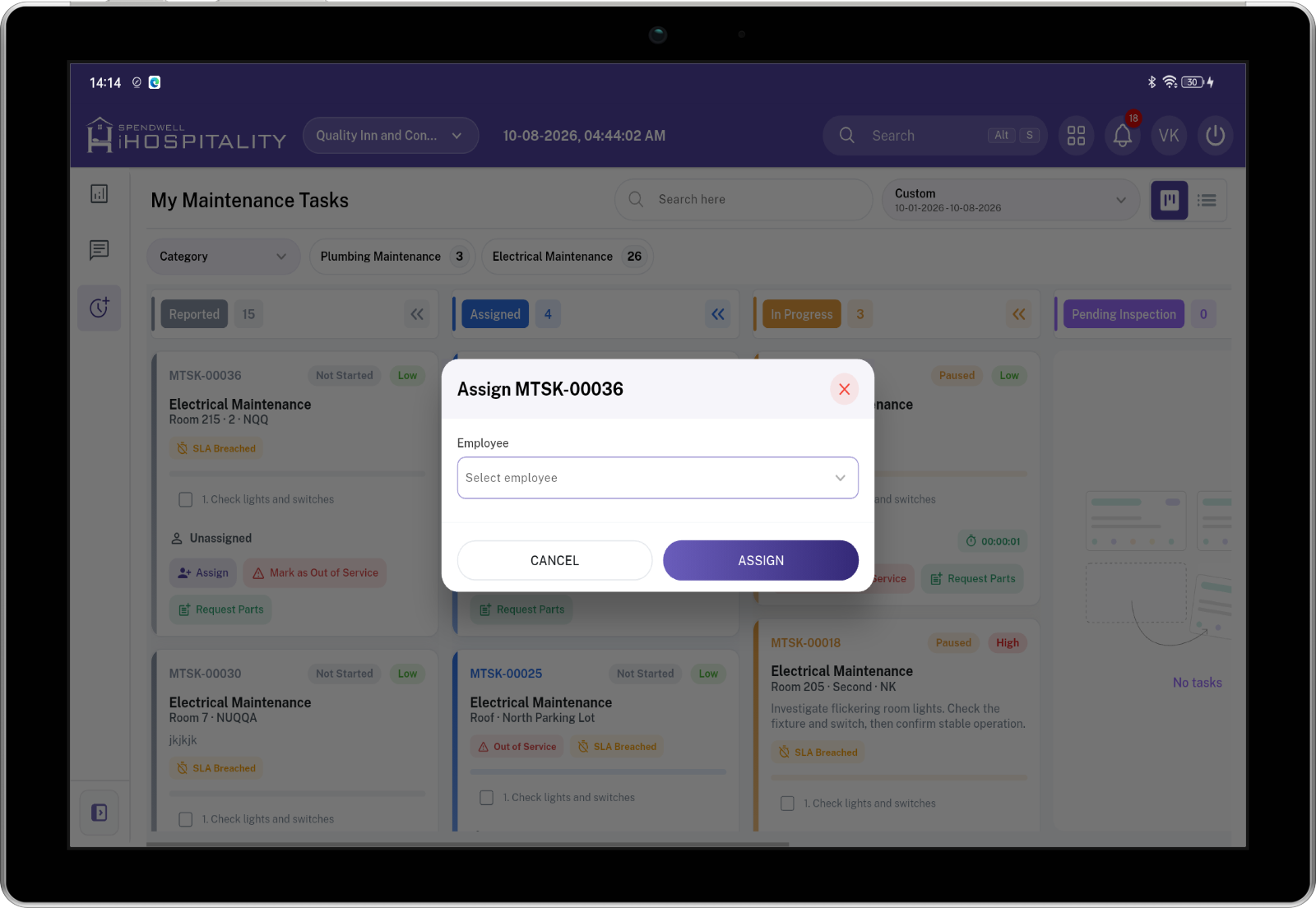
| Action | When it is available |
|---|---|
| Assign on a Reported card | Only active employees whose department is Maintenance are shown. The card moves to Assigned and that person is notified. |
| Drag a Reported card onto Assigned | Assigns it to you. |
| Reassign on an Assigned card | Before the timer starts. The previous technician is told it was removed. The new technician is told it is theirs. |
| Clear the technician | The card returns to Reported. |
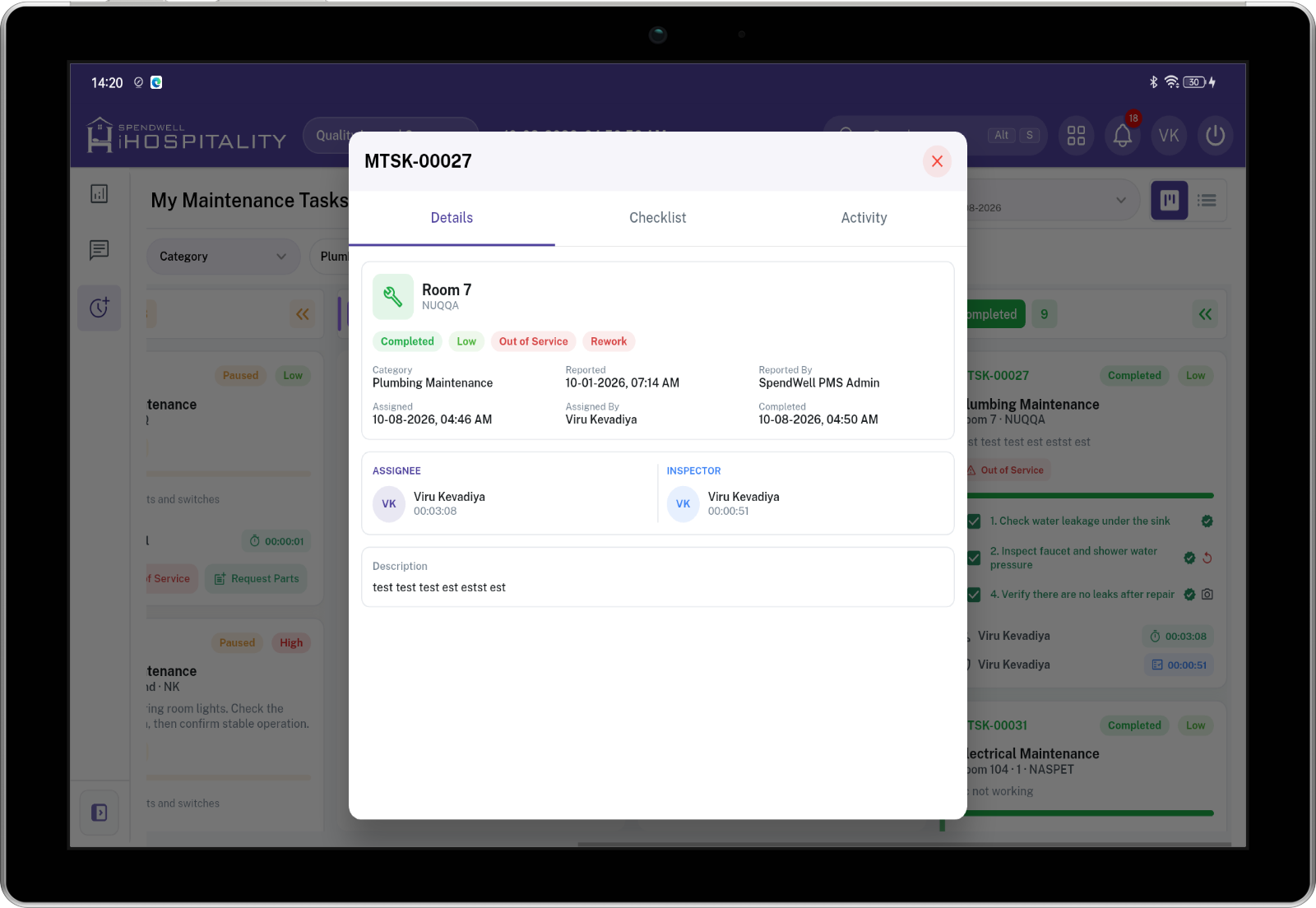
Details
Tap the work order code. Three tabs open.
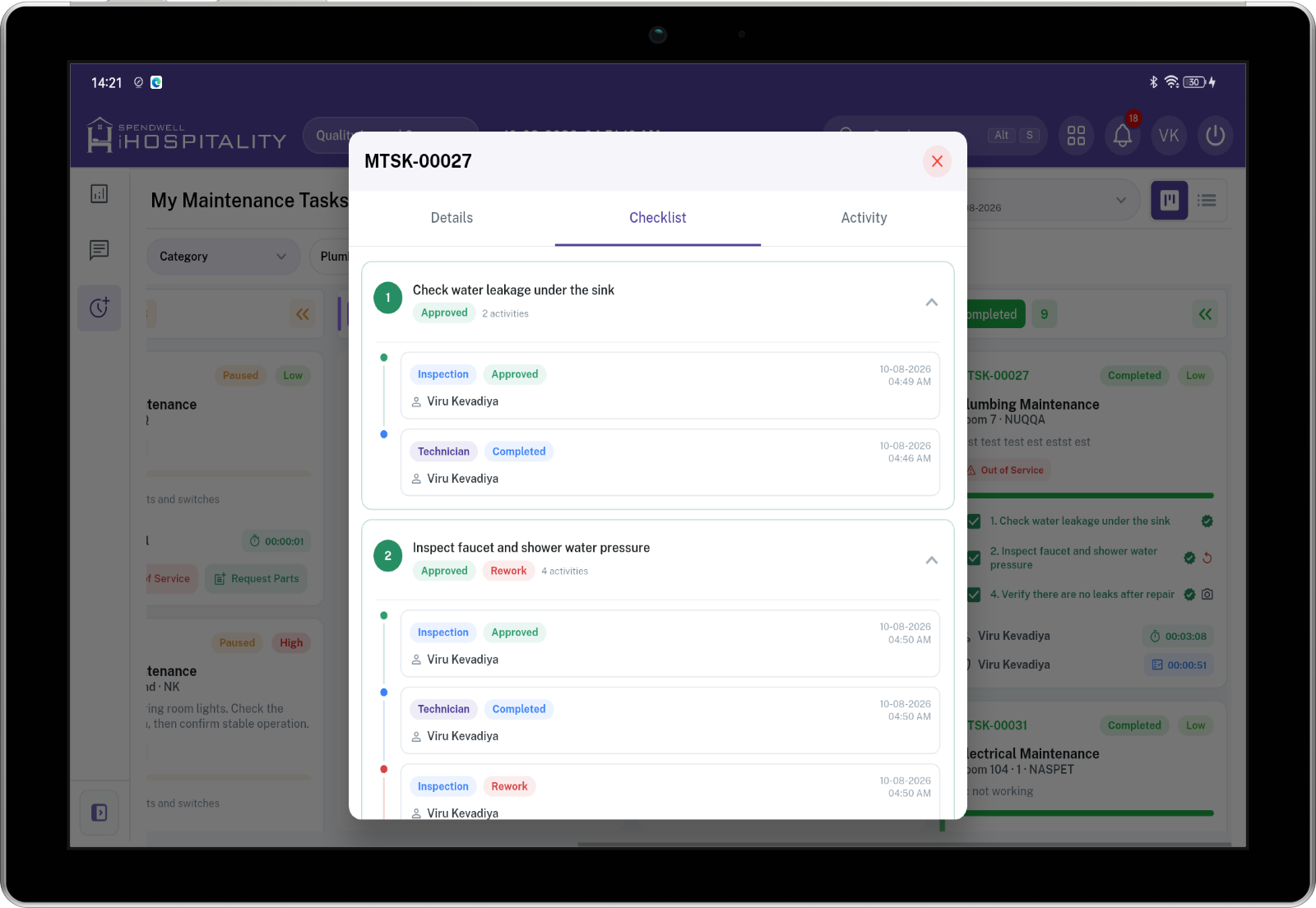
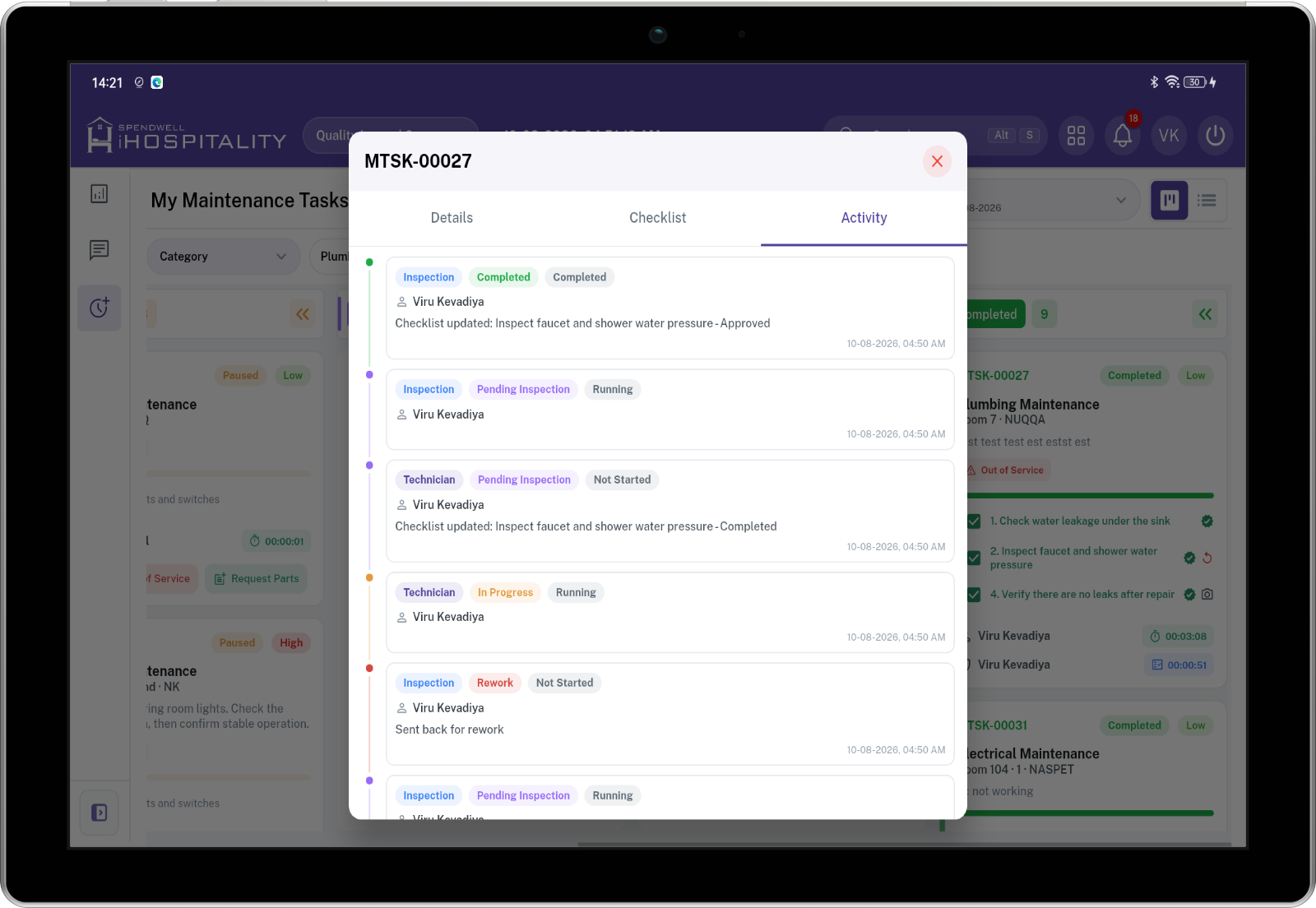
- Details shows location, priority, who reported it, who it is assigned to, the time target, and the dates.
- Checklist lists every step and its result.
- Activity is the history, newest first: assign, start, pause, checklist, parts, inspection, and out of service.
Notifications
You are not notified about an action you just performed.
| What happened | Who is told |
|---|---|
| Assigned | The new technician |
| Technician removed | The person who was removed |
| Ready for inspection | Everyone at the property in the allowed inspector roles, until someone starts it. After that, the inspector who started it. |
| Sent back for rework | The technician |
| Approved | The technician and the person who reported it |
| Completed by the technician, with no inspection | The technician and the person who reported it |
The notification opens Maintenance Task.
One job from report to close
Category Plumbing. Time target: 4 hours. Inspection is required. The inspector role is Maintenance Inspector. Steps: shut off the water, replace the supply line (note or photo required), test for leaks.
- Housekeeping reports a leak in room 109 and does not pick a technician. The card is in Reported. The due time is four hours after the report. All three steps are waiting.
- The Maintenance Inspector assigns Ramesh. The card moves to Assigned. Ramesh is notified.
- Ramesh taps Start. The card is In Progress and his timer is running.
- He completes the three steps in order and attaches a photo of the supply line. The card moves to Pending Inspection. People in the Maintenance Inspector role are notified.
- Priya taps Start Inspection. She approves the first and third steps and sends the supply line back with a note. The card moves to Rework. Ramesh is notified.
- Ramesh taps Start Rework, redoes the supply line, and attaches a new photo. The card returns to Pending Inspection.
- Priya approves the supply line. Every step is approved. The card moves to Completed. Ramesh and the housekeeper who reported it are notified.
If that category did not require inspection, finishing the steps in step 4 would approve them and move the card straight to Completed.